
You get the gross prize listed for the round where you lose. In doubles, the listed amount is for the pair. Qualifying, withdrawals and special formats follow their own rules.
What does a tournament's prize money figure mean?
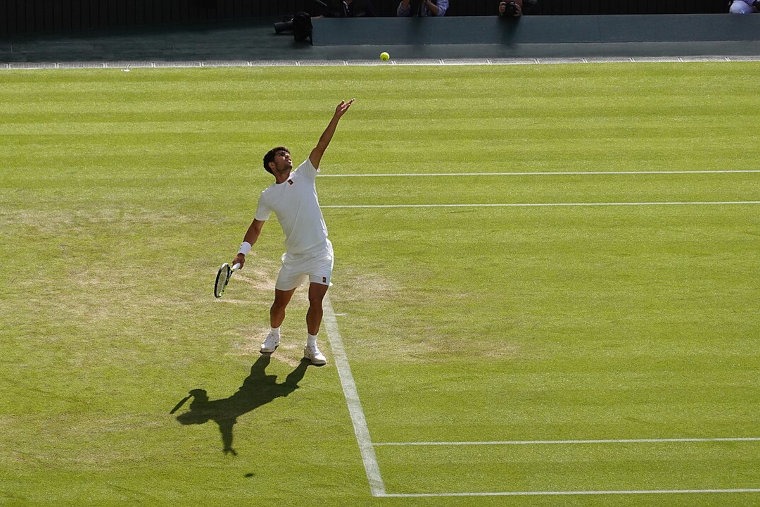
In professional tennis, the biggest advertised figure usually covers the whole event. A player's own prize depends on the round where the run ended, and in doubles the listed amount goes to the pair. Every amount in this article is gross, meaning before tax and expenses.
The figures below come from the US Open's official 2026 announcement, which said the initial Player Support Program commitment would be held in escrow until its details were finalized.
| Published category | What it describes | 2026 US Open example |
|---|---|---|
| Total player compensation | Organizer's event-wide compensation package | US$108 million |
| Singles winner's award | Gross prize for one singles champion | US$5.5 million |
| Doubles winner's award | Gross prize for a winning team | US$1 million per team |
| Player-support commitment | Separately designated funds within compensation | Initial US$2 million; escrow announced pending program details |
Wimbledon's £64.2 million headline in 2026 comprised £62.55 million in tennis-event prize money and an estimated £1.65 million in per diems.
How is prize money awarded by the round a player reaches?

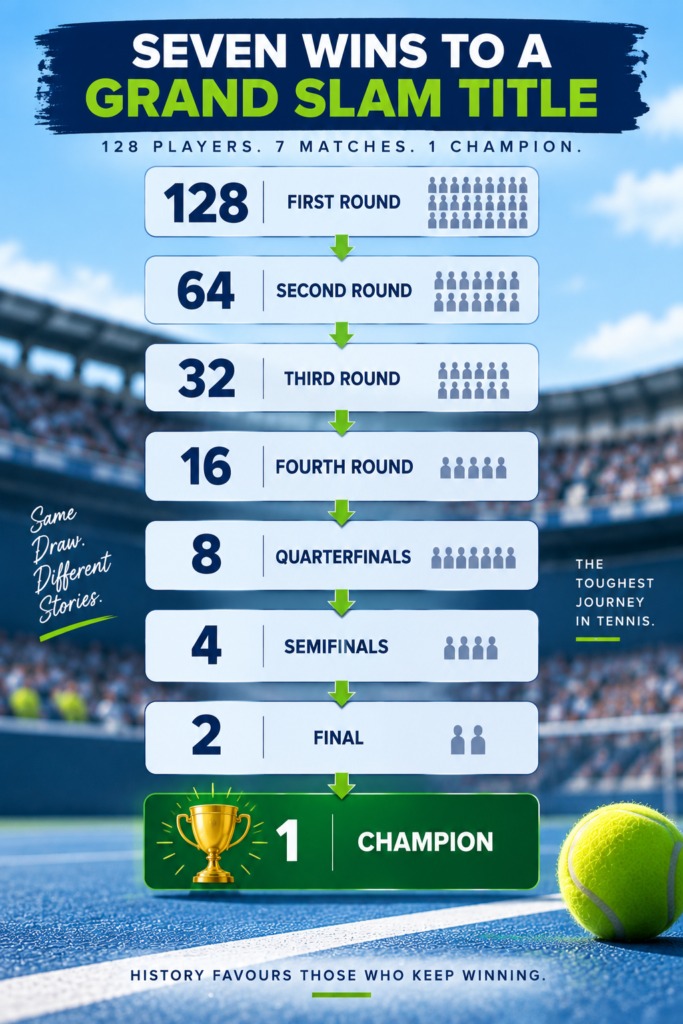
Each row in a knockout prize schedule stands for the round where a player's run ended. Nothing is added from earlier rounds.
The official Wimbledon 2026 singles schedule shows the full ladder:
| Final singles result | Prize, 2026 |
|---|---|
| First-round exit | £80,000 |
| Second-round exit | £126,000 |
| Third-round exit | £185,000 |
| Fourth-round exit | £300,000 |
| Quarterfinal exit | £480,000 |
| Semifinal exit | £900,000 |
| Runner-up | £1,800,000 |
| Champion | £3,600,000 |
Lose a Wimbledon singles semifinal and you collect £900,000.

Smaller draws start at a later round, so their schedules have fewer rows. Our guide on how tennis tournament draws work explains the stages.
Do players get paid for losing in the first round or in qualifying?

Yes. In the 2026 main draws, the US Open paid US$140,000 for a first-round singles exit, and the Australian Open listed A$150,000. Qualifying has its own schedule.
| Wimbledon 2026 qualifying exit | Singles prize |
|---|---|
| First qualifying round | £20,000 |
| Second qualifying round | £32,000 |
| Third qualifying round | £50,000 |
At Wimbledon in 2026, a player who lost in the first round of the main draw received £80,000 in singles. A player who lost in the first qualifying round received £20,000.
Under the 2026 ATP Rulebook, an ATP Tour or Challenger singles player who withdraws on-site before the first match can still receive first-round compensation. The player has to be at the venue, and the tournament doctor has to declare that player unfit. For main-draw withdrawals, the timing provisions apply after the qualifying freeze deadline or once qualifying begins. A player gets this in two nonconsecutive tournaments per calendar year at most, with further restrictions and exceptions. Grand Slam and WTA events follow their own rules.
What if a player wins through qualifying and then loses in the main draw?The main-draw round decides the prize. The qualifying rows apply only to players who went out during qualifying.
Singles versus doubles: who receives the listed prize?

Singles prizes go to one player. In doubles, the published figure covers both partners. The 2026 US Open listed US$1 million per team for each winning men's, women's and mixed-doubles pair. Wimbledon listed £760,000 per pair in men's and women's doubles and £148,000 per pair in mixed doubles.
Split a US$1 million team prize evenly and each partner gets US$500,000 before personal deductions.
A tennis fan commenting on the 2025 US Open mixed-doubles format was struck by how much money a short event paid:
$5M for the singles winner is obviously the headline, but even crazier is a $1M purse for the mixed doubles winning team who will have played two days worth of no-ad “best of three” matches with sets that only go up to four games each ☠️☠️
Why do Grand Slams, Challengers, and ITF events pay different amounts?
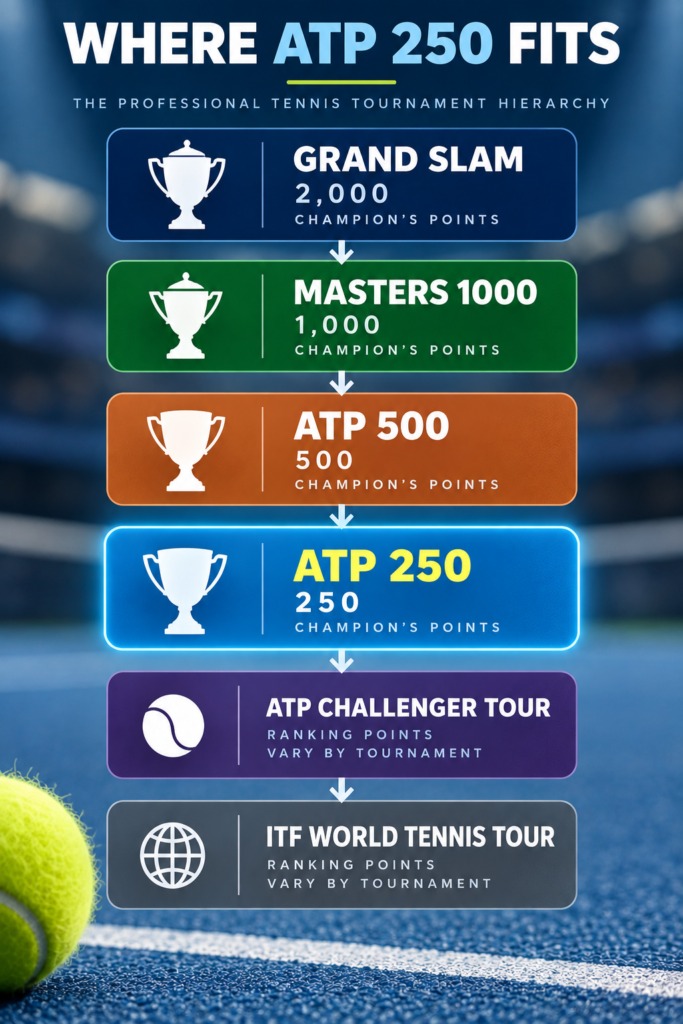
Professional tennis spans events with very different purses. A Grand Slam headline and an ITF category name describe the money for the whole event. The winner's prize comes from that event's prize table.
| 2026 Grand Slam | Announced total | Singles champion | Main-draw singles R1 |
|---|---|---|---|
| US Open | US$108 million player compensation | US$5.5 million | US$140,000 |
| Wimbledon | £64.2 million including estimated per diems | £3.6 million | £80,000 |
| Australian Open | A$111.5 million prize pool | A$4.15 million | A$150,000 |
Each Grand Slam event is listed in its own currency.

Take the ITF's 2026 W35 category, which has a US$30,000 event purse. Under the ITF Women's World Tennis Tour Appendix J schedule for a 48-player singles main draw, the champion receives US$3,935 and the runner-up US$2,120. A first-round main-draw exit pays US$125.
ATP Challenger categories have their own event purses. The 2026 Challenger 50 schedule lists US$63,000 or €56,700, and Challenger 175 lists US$300,000 or €272,720. Those are category-wide amounts in each currency.
Who sets the schedules, and how are prizes funded and paid?
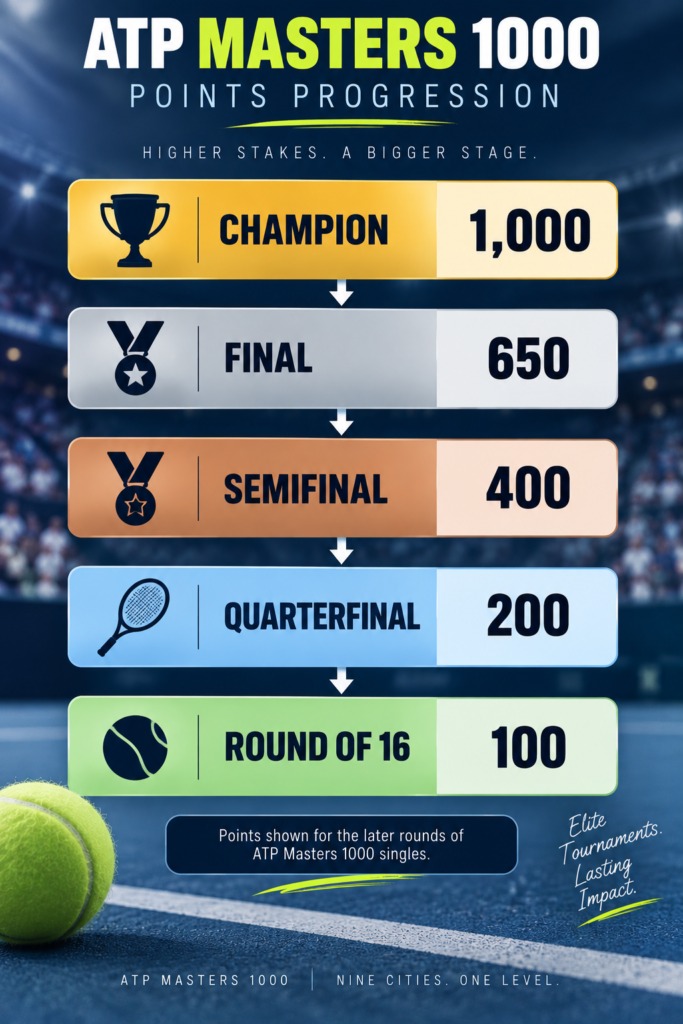
Grand Slam organizers publish their own schedules, while ATP, WTA and ITF competitions follow their regulations. Under the ATP's 2026 Rulebook, ATP Tour and Challenger prize money is normally paid through ATP or a designated agent after the tournament, with approved exceptions. For ATP Masters 1000 events, an audited profit-sharing formula draws on ticketing, media and sponsorship revenues and allocates eligible profits above Base Prize Money, separately from the round prizes.
Are professional tennis players paid a salary or guaranteed a minimum?

Players mostly earn through tournament results rather than a salary. The ATP's Baseline Financial-Security Programme continued in 2026, with minimum-income protection for eligible players in specified categories, including thresholds linked to the Top 250.
ATP reported more than US$2 million in Baseline support during 2025. For 2026 it also announced a US$21.5 million bonus pool for Masters 1000 events and the ATP Finals, plus a US$3.07 million ATP 500 bonus pool.
A Reddit commenter discussing the program in 2024 questioned whether the support reaches players facing heavy touring costs:
I’d be interested to see how many players actually benefit from the “baseline” payments - it sounds good in theory, but most players in those brackets end up earning above the thresholds that they’ve set. It also doesn’t account for all the expenses (flights, coaching staff, accommodation when you’re not in a tournament/between events etc) - which would be a lot higher for a tennis player than someone playing a team sport where expenses are covered. Lower ranked players are also less likely to benefit from big sponsorship deals etc
Why does published prize money differ from take-home pay?

Published prize money is what a player receives on court. Take-home pay depends on three more things: the costs of competing, taxes, and income from outside the prize tables, such as sponsorships.
Touring professionals pay for travel between events, accommodation, coaches and other staff, and equipment. They also spend time preparing and competing without a win to show for it. Sponsorship or tournament arrangements sometimes cover some of these costs or services.
A player with US$500,000 in annual prize receipts still has substantial expenses and taxes to pay, so that total says nothing about what the player keeps.
How do taxes and withholding affect a player's prize?

For a nonresident alien athlete receiving U.S.-source compensation for independent personal services, federal withholding is usually 30% of gross payments. The IRS guidance for foreign athletes covers the details.
Tax treaties, exemptions and an approved Central Withholding Agreement can change the withholding. The amount held back at payment and the final tax bill are separate calculations.
A player competing in several countries also faces questions about where income is taxable and how double-taxation relief applies.
How can you verify an official tennis prize-money figure?
Start with the organizer's published schedule for the specific tournament edition.
- Identify the event and edition. Note the tournament name and year.
- Find the official payout schedule. Use the organizer's table or the ATP, WTA or ITF regulation for that competition.
- Pick the draw and event type. Separate qualifying from the main draw, and singles from doubles or mixed doubles.
- Read the row for your result. Use the amount listed for the round where the run ended.
- Check the unit. Note the currency and whether the figure covers one player, a pair, a whole purse or a separate support component.
- Check for exceptions. For a withdrawal, default, walkover or special format, read the event's own rule.