In a standard professional singles knockout, the draw shows every opponent a player could meet on the way to the final. Seeds get protected spots, the other players fill the remaining places, and byes cover the first-round spots with no opponent. Round-robin events work differently, and withdrawals can change a draw, so check the official draw before counting on any matchup.
What a Tennis Draw Shows
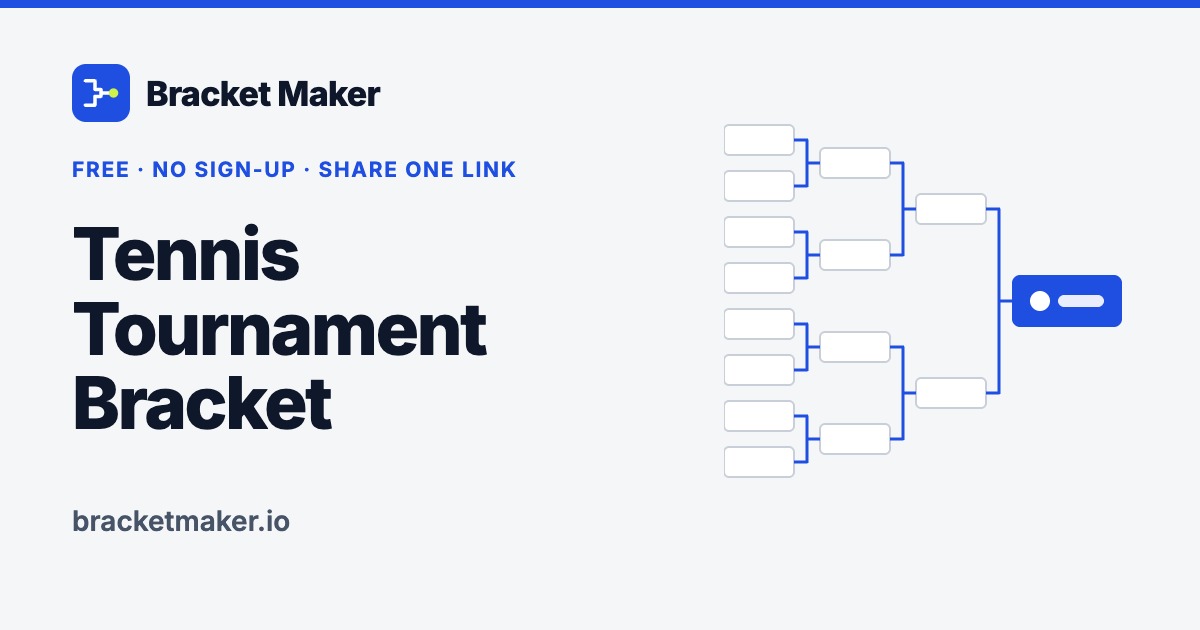
A tennis draw does two things. It assigns players to tournament positions, and it produces the bracket of possible matchups. As matches finish, winners fill in the branches.
The order of play is the daily schedule that assigns matches to courts and times. A bracket can show a possible quarterfinal days before either opponent reaches it.
In a standard singles knockout, the winners of adjacent opening matches meet in the next round, and the top and bottom halves meet in the final. This fictional eight-player example uses the opening matches as quarterfinals. The labels in parentheses show seeds and entry categories.
Quarterfinals (first round)      Semifinals                     Final
A (1) vs B (WC) ─┐
                 ├ Winner A/B vs Winner C/D ─┐
C (Q) vs D ──────┘                            │
                                              ├ Upper winner vs lower winner
E vs F (LL) ─────┐                            │
                 ├ Winner E/F vs Winner G/H ─┘
G vs H (2) ──────┘
A and H sit on the top and bottom lines as the fictional No. 1 and No. 2 seeds. B is a wild card, C a qualifier and F a lucky loser. Every “Winner” slot stays empty until the matches are played.
How Seeds Are Placed in a Tournament Draw
Seeds get protected positions that keep the highest-seeded players apart in the early rounds as long as they keep winning. The seed list belongs to the event, and it can differ from a player's world ranking because entry fields and tournament rules shape the seeding.
The 2026 Grand Slam Rule Book puts seed No. 1 on line 1 and seed No. 2 on line 128 of a 128-position singles sheet. They sit at opposite ends and can meet only in the final.
The remaining seeds in a 128-position Grand Slam singles draw with 32 seeds go into these groups:
- Seeds 3 and 4: Drawn into set positions in opposite halves.
- Seeds 5 through 8: Placed within the next protected group.
- Seeds 9 through 12 and 13 through 16: Each range goes into a separate four-player group.
- Seeds 17 through 24 and 25 through 32: Each range goes into its own eight-player group.
Fans noticed this during the 2022 French Open and asked why No. 1 could be projected to face No. 5 in a quarterfinal and No. 3 in a semifinal.
It seems like the 1 is disadvantaged by having to play the 5 instead of the 8 in the QF and the 3 instead of the 4 in the SF. The 4 gets a huge advantage playing the 8 in the QF instead of the 5.
The imbalance comes from expecting a single fixed order. In the Grand Slam procedure, each seed group has its own set of available positions, and another event or draw size may place seeds differently.
Why Seed Positions Can Vary Between Tournaments
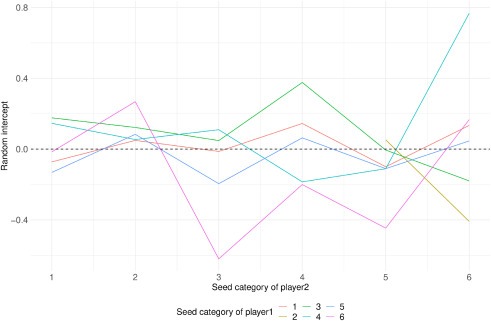
Seeds are placed by group, not on a fixed line for each number. The rules keep the seed bands apart but allow more than one placement inside each band, so No. 1 can face different seeded opponents in a later round from one comparable draw to the next.
One fan argued that the variation itself makes tournaments more interesting:
Draws would be extremely stale from tournament to tournament if it was a rigid system like you suggest, as the points don't move enough from week to week to shift things up enough: you'd end up with the same matchups for consecutive tournaments, and that would just be a drag.
Why a 28-Player Draw Has 32 Slots and Where Byes Go
A 28-player singles field uses 32 bracket positions, which leaves four initial byes. In the standard ATP 28-player main draw under the 2026 rules, the top four seeds get those byes. The other 24 players play 12 opening matches, and the winners join the four bye recipients to form a 16-player second round.
The 2026 ATP Official Rulebook and the 2026 WTA bye allocations back these field sizes. The first-round match counts are simple arithmetic from those sizes.
| Singles entrants | Bracket positions | Initial byes | First-round matches | Round-two players |
|---|---|---|---|---|
| 24 | 32 | 8 | 8 | 16 |
| 28 | 32 | 4 | 12 | 16 |
| 30 | 32 | 2 | 14 | 16 |
| 48 | 64 | 16 | 16 | 32 |
| 56 | 64 | 8 | 24 | 32 |
| 96 | 128 | 32 | 32 | 64 |
| 128 (full Grand Slam field) | 128 | 0 | 64 | 64 |
To find the initial byes, subtract the number of entrants from the sheet's capacity. To find the opening-round matches, subtract those byes from the entrants and divide by two.
A bye sends a player straight to round two. No match is played and no win is recorded. In a 32-position knockout, a player with an initial bye needs four match wins to take the title, while a player starting in round one needs five.
Original seeded byes follow the event's draw-allocation rules. A later withdrawal is handled by a separate replacement procedure.
What Q, WC, and LL Mean Beside a Player's Name
Small letters next to a name show how a player entered the main draw. A seed number shows protected placement.
| Marker | Meaning | Reader interpretation |
|---|---|---|
| DA or no special marker | Direct acceptance | Entered through the main-draw acceptance procedure |
| Q | Qualifier | Earned a main-draw spot through qualifying |
| WC | Wild card | Received a discretionary entry from the event |
| LL | Lucky loser | Eligible player from qualifying who fills a main-draw vacancy |
| BYE | First-round bye | Advances without a first-round opponent |
A qualifier's name appears once qualifying finishes and replaces a reserved Q position. A lucky loser is an eligible qualifying player who missed out on a main-draw place but takes a vacant one.
A wild card can still be seeded when the competition rules allow it. Entry route and seeding are separate things.

For Grand Slam singles, the 2026 rulebook lists a full field of 128 entrants with eight wild cards and one of three combinations of qualifiers and direct acceptances: 16 qualifiers and 104 direct acceptances, 12 and 108, or eight and 112. Each combination fills the same 128 positions.
Why a Published Draw Can Change After Qualifying
A bracket changes when qualifying places get names and when a withdrawal opens a vacancy. Which replacement procedure applies depends on the competition and the timing of that vacancy.
| Situation | Visible change | What governs it |
|---|---|---|
| Qualifying unfinished | Q placeholder becomes a named player | Results and qualifying placement rules |
| Seed withdraws before the first Order of Play | Another seed may move into its position | The event's seed-vacancy procedure |
| Scheduled match cannot begin | Replacement or walkover status may appear | Match stage, eligibility and tour rules |
The 2026 WTA Official Rulebook sets its own lucky-loser eligibility, sign-in and replacement rules.
The 2026 Grand Slam rules set a specific sequence when a seed numbered 1 to 4 withdraws before the first day's main-draw Order of Play is released. Seed No. 5 moves into the vacated seeded position. Seed No. 17 takes No. 5's former position, and the next eligible seed fills the opening left by No. 17. How the resulting vacancy is filled depends on whether qualifying has begun. If a seed withdraws after the first day's main-draw Order of Play is released, an eligible lucky loser fills that position.
Under the ATP glossary, a walkover is a match that cannot begin because a player is ill, injured, or barred from starting by disciplinary or eligibility rules.
One fan noticed an unusually crowded lucky-loser column at the Nottingham WTA event in June 2026 and asked how many replacements a tournament can have:
Just noticed that Nottingham this week on the WTA had six lucky losers in the main draw, with everyone who made the final round of qualifying all making it into the main draw (I'd assume starting with the seeded players who lost, then the unseeded players which ended up being everyone with six qualifer sections and six lucky losers spots to fill. Got me wondering what tournament had the most lucky losers in a single event, grand slams or main tour? Seems quite unusual for an event to need to count back to the first round to fill the spots
At Nottingham, June 15 to 21, 2026, the official WTA player list identifies six lucky losers: Kimberly Birrell, Anna Bondár, Alicia Dudeney, Sofia Kenin, Hannah Klugman and Taylah Preston.
Whether six is the all-time record for one event remains an open question.
How to Trace a Player's Possible Route to the Final
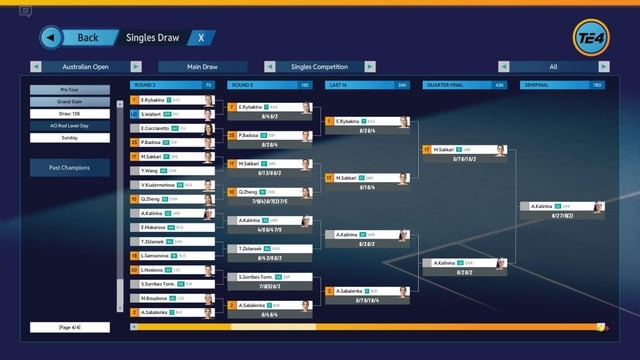
The fictional eight-player bracket shows possible opponents before any match is played. A opens against B (WC). The winner then meets the winner of C (Q) against D in the semifinal, so A's possible semifinal opponents are C and D.
Suppose A beats B and D beats C. The upper semifinal becomes A against D. If A wins, A reaches the final. The finalist from the other half is decided separately.
Now suppose G beats H (2), then beats the winner of E against F (LL). If A has won its semifinal, the final is A against G. H's seed number protected its placement but did not prevent a first-round loss.
When an upset changes who advances, the branch itself stays where it is.
In a complete eight-player knockout, the champion wins three rounds. In a complete 128-player knockout with no byes, the champion wins seven.
What Seed Numbers Say About Match Difficulty

A seed number tells you where a player sits in the bracket. It does not predict how hard a match will be. That depends on the actual opponent, current form, the playing surface and earlier results.
A high seed can draw an unseeded opponent whose game suits the surface, while another high seed faces a different set of styles and conditions.
When a Tennis Tournament Uses Round-Robin Groups
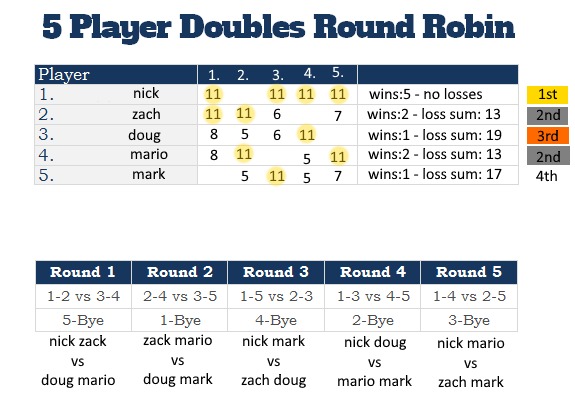
Some season-ending events, including the ATP and WTA Finals formats, start with round-robin groups and then move to knockout matches. A player can lose one group match and still advance through the standings.
How to Check the Official Tournament Draw

The official event sheet is the reference for a player's assigned position, match results and later revisions. Read it in this order:
- Pick the event. Confirm the tournament and whether the bracket is singles or doubles.
- Choose the stage. Open the main draw or qualifying, and tell knockout branches apart from group standings.
- Find the opening pairing. Locate the player and the neighboring position on the draw sheet.
- Read the labels. Check the seed number and any Q, WC or LL marker, and separate an original first-round bye from a later withdrawal or walkover.
- Follow the branch. Find the next-round position the winner of that pairing reaches.
- Check for revisions. Compare against the latest official sheet after qualifying or withdrawals change an entrant. For procedural disputes, use the regulations and rule edition for that specific event.