
Before your first lesson or match, learn the singles and doubles lines and find out whether the court is hard, clay, grass, or an artificial surface. The layout is regulation everywhere. Bounce and footing change with the surface, so prepare for the one you'll play on. Exact measurements, line rulings, and deeper surface comparisons each have a detailed guide.
Read a Tennis Court at a Glance
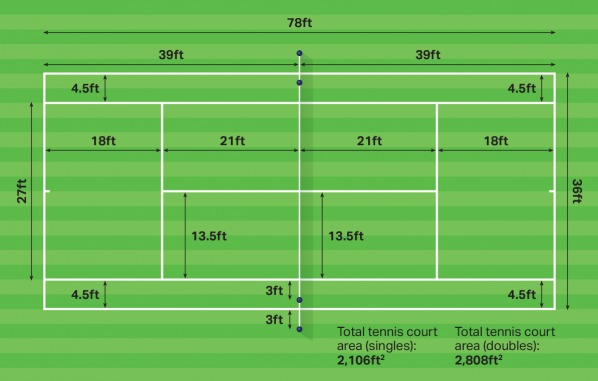
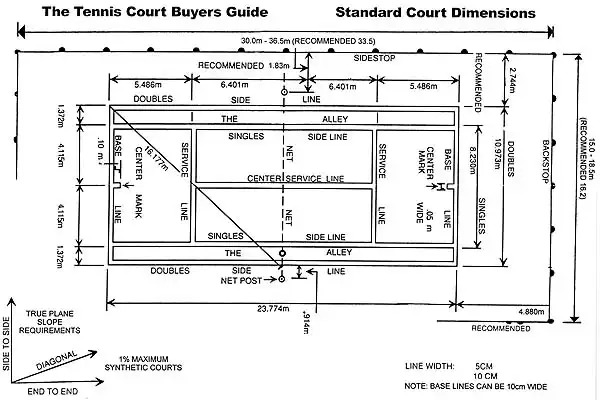
A net splits a full-size court in two. On a court marked for both formats, two sets of sidelines share the same painted area: the inner pair is the singles boundary, and the outer pair adds the doubles alleys.
| Court feature | Measurement | What it means in play |
|---|---|---|
| Length | 78 ft | Distance between the two baselines |
| Singles width | 27 ft | Inner sidelines are the rally boundaries |
| Doubles width | 36 ft | Outer sidelines include the doubles alleys |
| Net height | 3 ft at the center; 3 ft 6 in at the posts | The net separates the two sides of the court |
| Service courts | Between the singles sidelines, service line, and center service line | The serve must reach the diagonally opposite service box |
These are the full-size dimensions set out in the ITF Rules of Tennis. A ball touching a boundary line that applies to the shot is in.
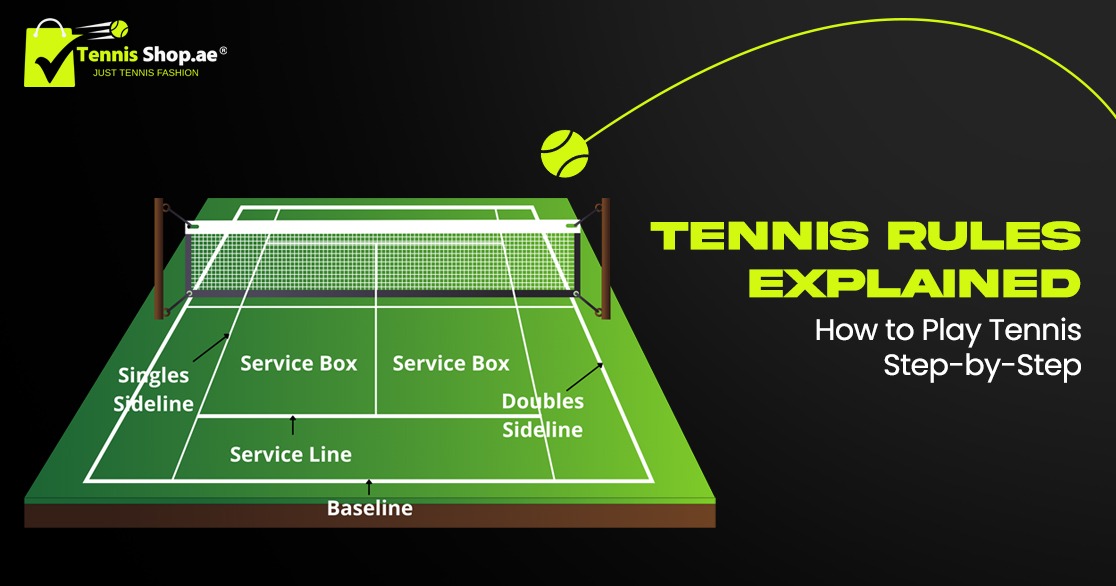
A ball that lands in the strip between the inner and outer sidelines is out in a singles rally and in during doubles. Serving works differently. In either format the serve must land in the diagonally opposite service box, so the doubles alley is out on a serve.
Junior programs use adapted courts: red-ball play includes 36-foot courts, while orange-ball play includes 60-foot courts.
Hard, Clay, Grass, and Artificial Tennis Courts
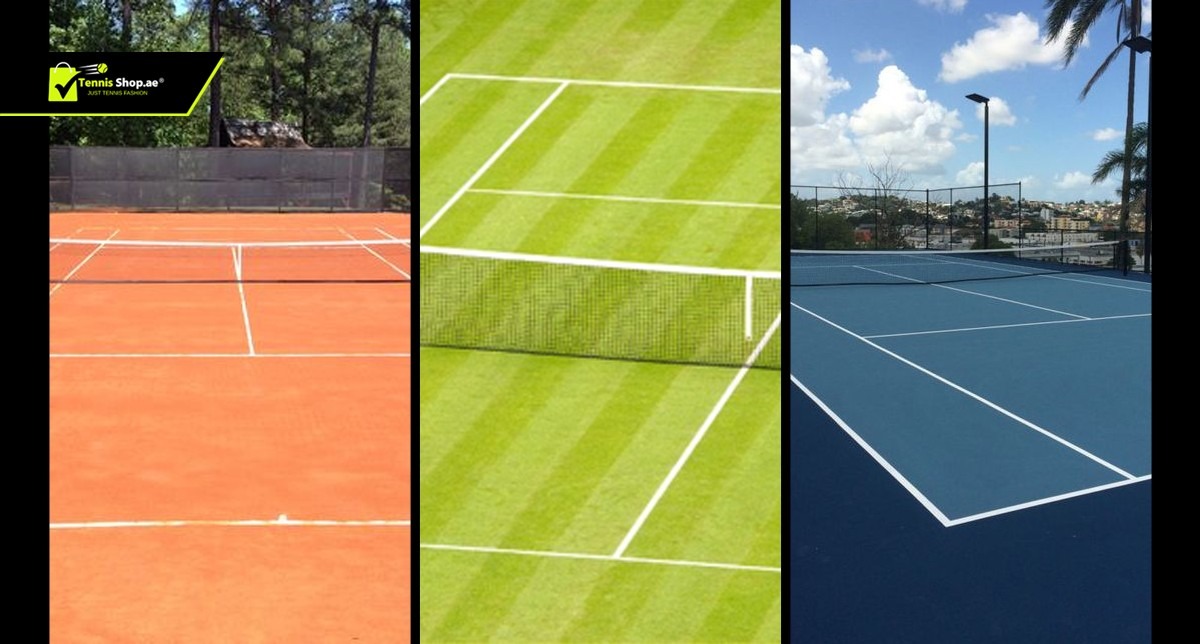
Hard court, mineral clay, and natural grass are the familiar choices. The ITF surface taxonomy also recognizes several engineered systems.
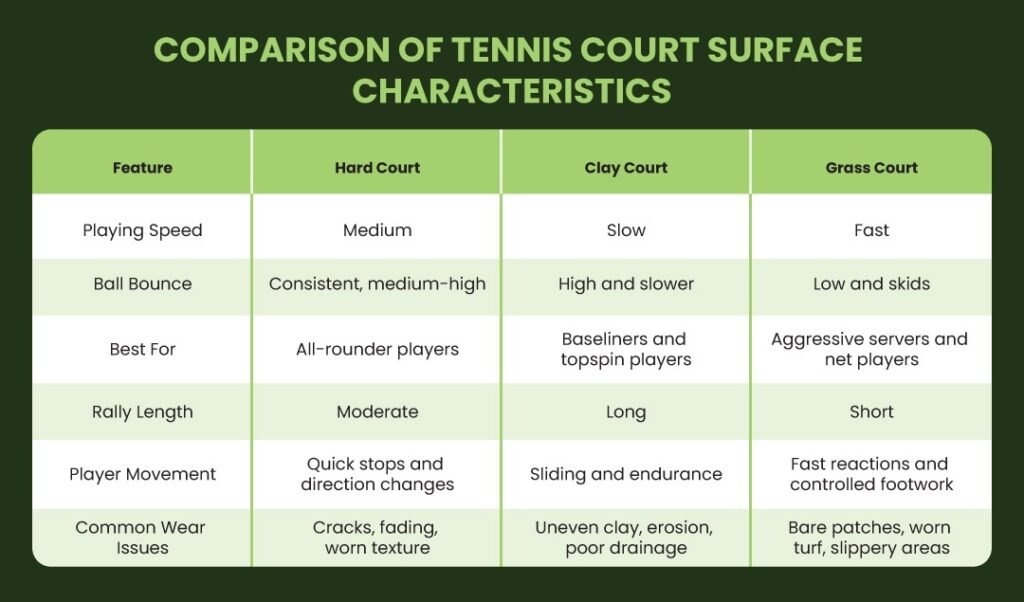
| Surface family | Construction | How it plays | What varies |
|---|---|---|---|
| Hard | Acrylic or polyurethane over asphalt or concrete | Relatively predictable bounce | Coating, base, and court condition |
| Clay | Mineral playing surface | Higher, slower bounce; you can slide into shots | Mineral system, moisture, and upkeep |
| Natural grass | Maintained living grass | Lower, quicker ball response | Grass condition and maintenance |
| Artificial systems | Artificial grass, artificial clay, carpet, and hybrid systems | Depends on the installation | Materials and construction vary widely |
A green-painted hard court and a green artificial surface can look similar at a distance. Their construction defines the surface family.
Why the Surface Name Doesn't Tell You Exactly How It Plays
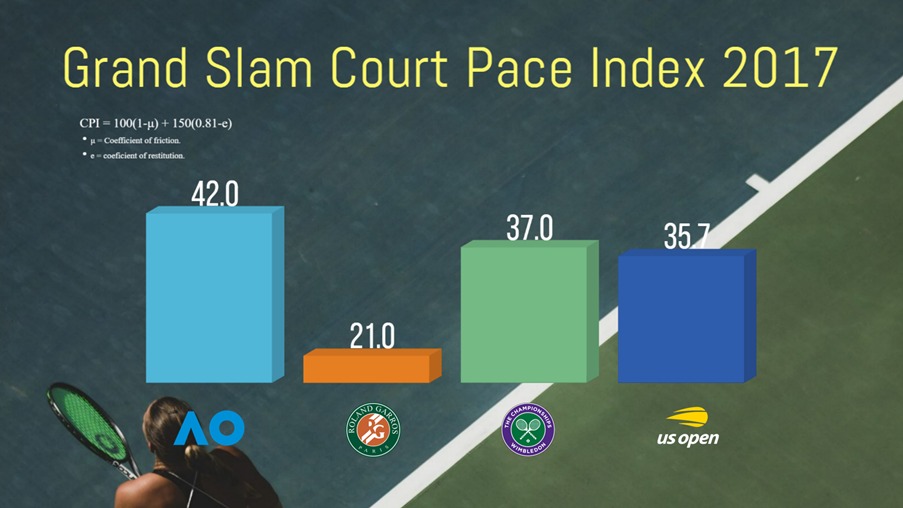
Material, measured pace, and how a court feels during a match are three related things. The ITF's Court Pace Classification Programme uses controlled testing to assign surface products to five categories:
- Category 1: slow
- Category 2: medium-slow
- Category 3: medium
- Category 4: medium-fast
- Category 5: fast
An ITF classified surface is a tested product. The rating covers the product, not the current speed or condition of any court where it's installed.
The ITF states that a listed product's classification is not an ITF endorsement.
Two clubs can both advertise hard courts and still differ in coating, upkeep, and ball response.
What U.S. Players Mean by Green Clay and Har-Tru
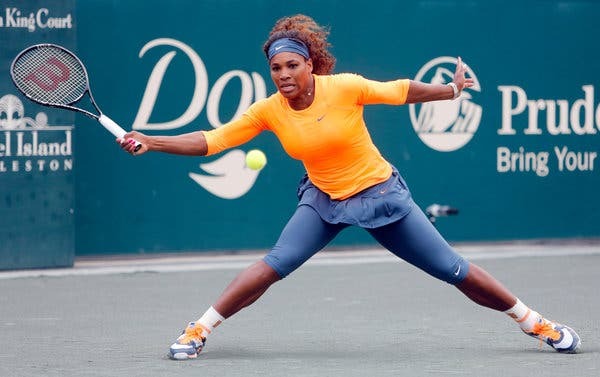
The USTA Public Parks Resource Guide describes green clay as more common in the United States and Canada, while red clay is more common in Europe and Latin America. Har-Tru is a commercial green-clay product name; clay is the broader category. If you're used to hard courts, expect a different bounce and possibly some trouble seeing the lines on green clay.
What Changes When You Switch Tennis Court Surfaces?
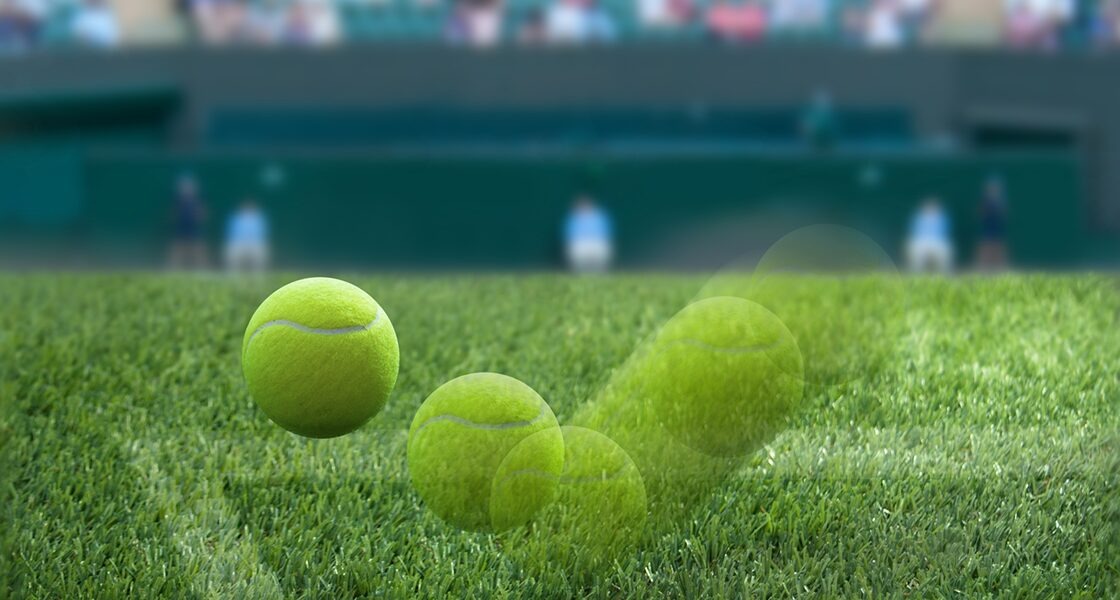
Familiar strokes can feel mistimed when the bounce changes.
Ball height and contact timing
Move from hard court to grass and the ball stays lower than you expect. Your usual contact point is too high, and a routine groundstroke feels awkward. Move from hard court to clay and the ball sits up higher and arrives on a different rhythm.
Movement and shoe traction
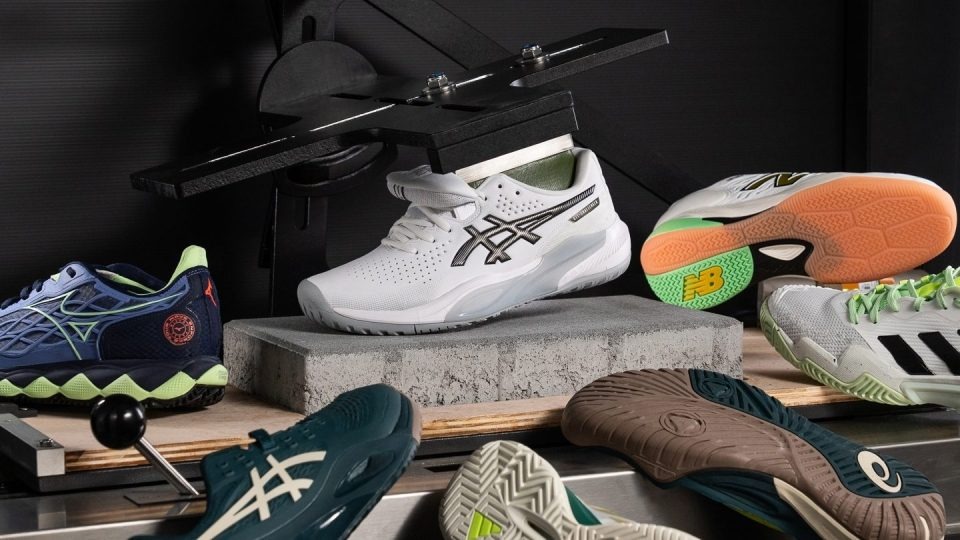
You can read the ball fine and still slip or grip differently. Shoe tread, surface texture, and how hard you push all affect traction. Clay-oriented tennis shoes often have herringbone tread, while other tennis outsoles are designed for different surfaces.
A Five-Step Check Before Playing on an Unfamiliar Court
Before a lesson, social match, or tournament at a new venue, run through these five checks.
- Confirm the surface and access rules. Find out whether you've booked hard court, clay, grass, or an artificial system. For an organized event, follow the venue or event instructions.
- Settle the format. Agree on singles or doubles so everyone knows which sidelines and service target apply.
- Inspect the surface and lines. Look for moisture, unusual patches, loose material, and lines that are hard to see. If the court looks wrong, tell the staff. Don't fix it yourself.
- Match your footwear to the rules. Check for shoe restrictions and whether your soles suit the assigned surface. The venue's stated requirements come first.
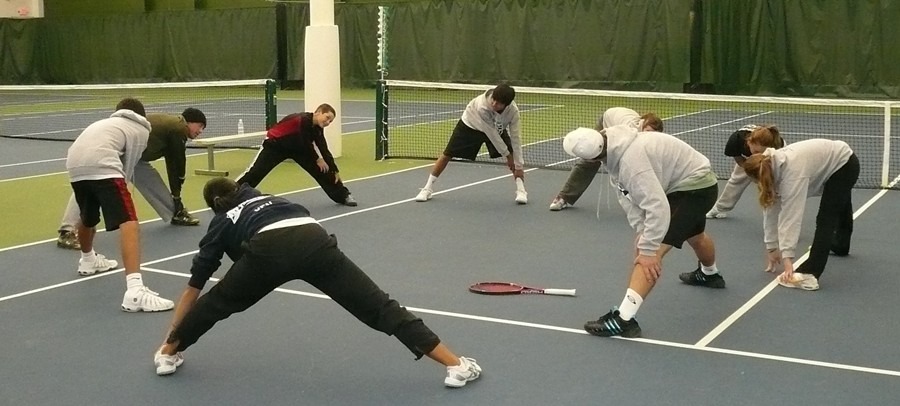
- Use the warm-up. Start with controlled movement and hitting, and notice bounce height, timing, and traction before you push harder.
Where to Find More Specific Court Answers
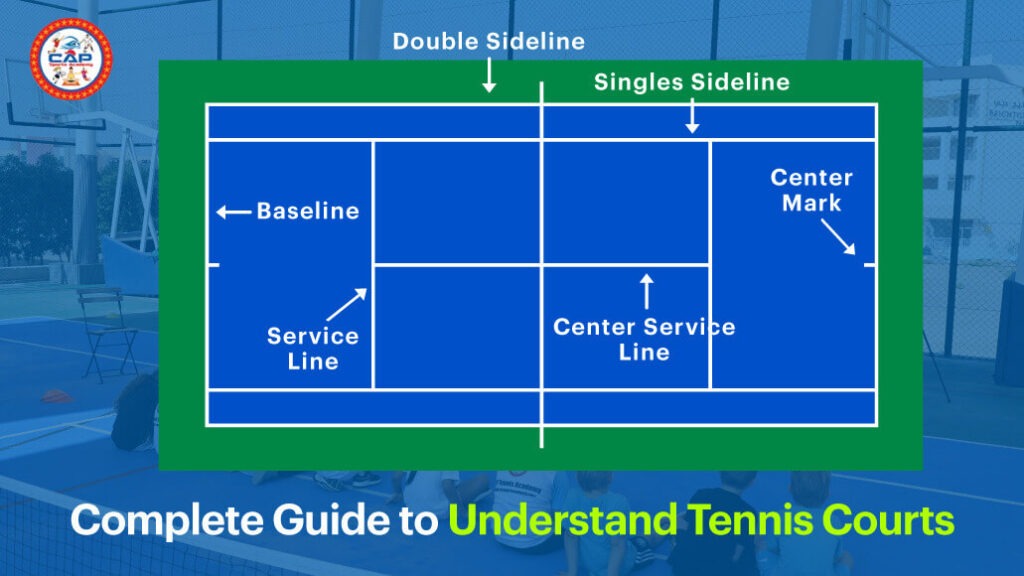
- Court dimensions: exact measurements, unit conversions, and a fully labeled court diagram.
- Court lines and areas: service-box boundaries, singles and doubles alleys, and line-call situations.
- Playing surfaces: a deeper comparison of hard, clay, grass, and artificial systems, including playing characteristics and conditions.
- Specialized needs: tennis shoes by surface, junior court formats, or finding a local court to play on.