
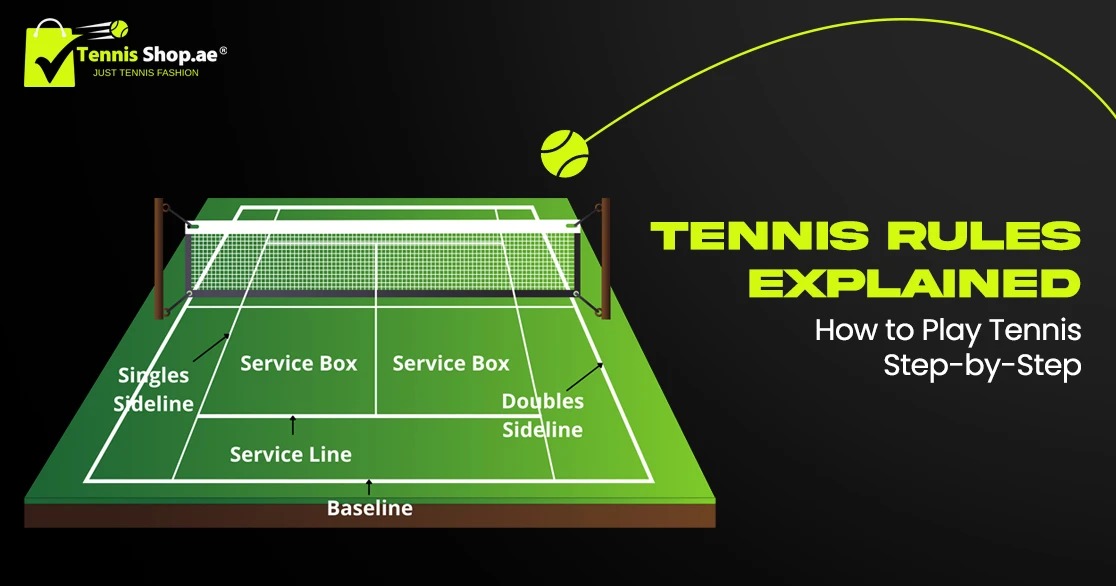
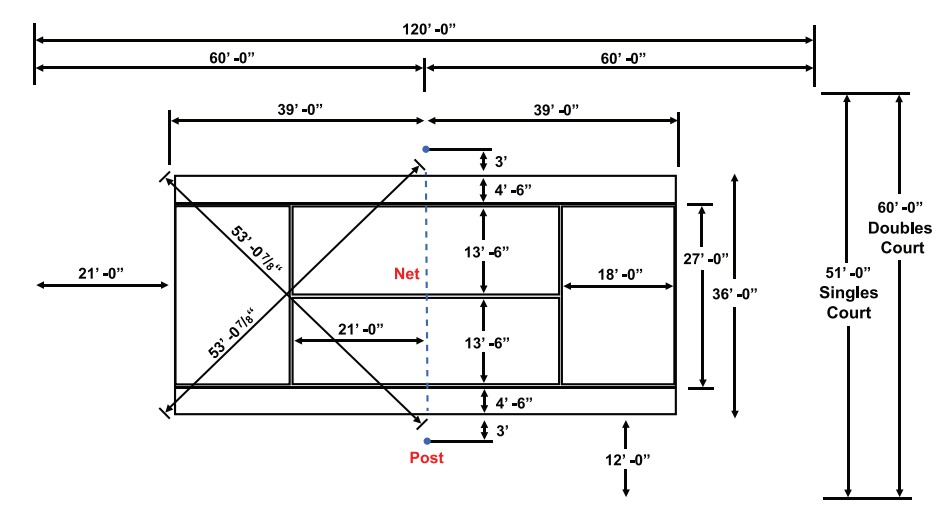
A full-size tennis court is 78 feet long and 27 feet wide for singles or 36 feet wide for doubles. Both formats serve into boxes bounded by the singles sidelines. Run-off space sits outside these dimensions, and authorized junior courts use smaller layouts.
Standard Tennis Court Dimensions: Singles vs. Doubles
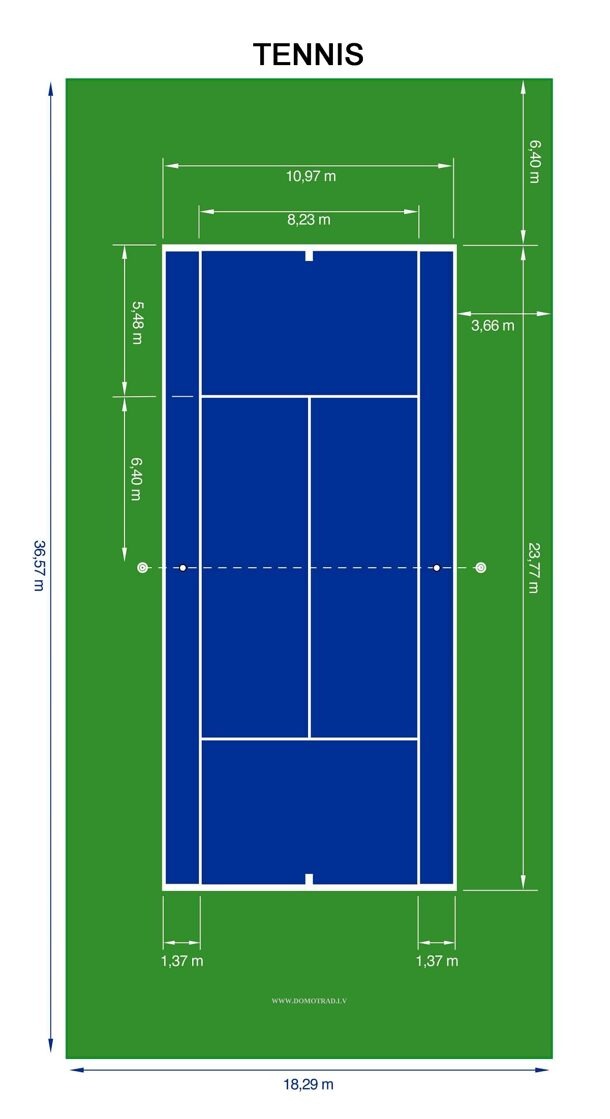
The only difference between a singles court and a doubles court is width.
| Measurement | Singles | Doubles |
|---|---|---|
| Length | 78 ft (23.77 m) | 78 ft (23.77 m) |
| Width | 27 ft (8.23 m) | 36 ft (10.97 m) |
| Playing area | 2,106 sq ft (approx. 195.65 m²) | 2,808 sq ft (approx. 260.87 m²) |
| Doubles alleys | Outside the singles playing area | 4 ft 6 in (approx. 1.37 m) on each side |
The lengths and widths come from the International Tennis Federation's Rules of Tennis 2026. Areas are length times width.
Which Lines Are In for Singles and Doubles?
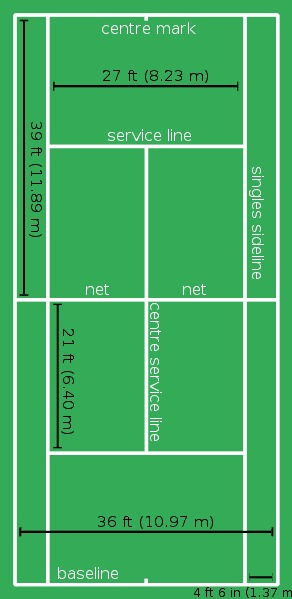
Singles rallies use the inner sidelines and doubles rallies use the outer ones. Both share the same baselines at either end.
A groundstroke that lands in the strip between the inner and outer sidelines is out in singles and in for doubles. Under ITF Rule 12, a ball touching the boundary line that applies to the shot is in.
Close calls cause the most arguments. One player described a USTA doubles match:
I had a USTA doubles match last night. We were on serve at 4-5, and I was serving. In that game, our opponents had 2 egregious line calls and the 2nd call won them the set. One was a serve that was inside the line by about 3 inches, and one slow slice that was close but definitely in. We pushed back on both, but they would not budge.
Serves have a narrower target.
Where Are the Service Boxes on a Tennis Court?
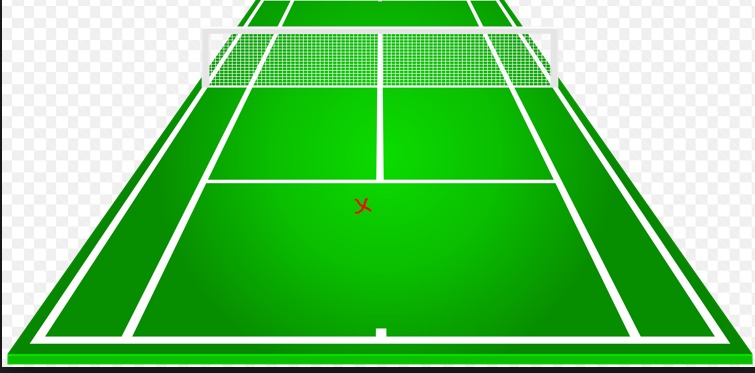
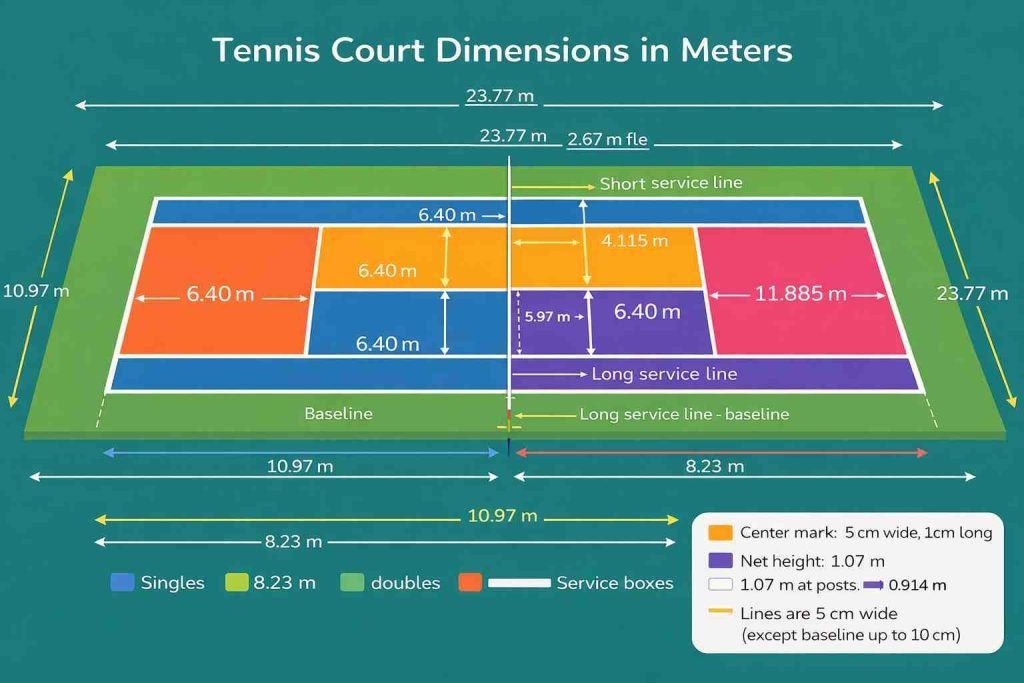
Each service box extends 21 feet (6.40 m) from the net to the service line and measures 13 feet 6 inches (about 4.115 m) across. The center service line divides the 27-foot space between the singles sidelines into two equal widths on each side of the net.
Between each service line and its baseline, the court measures 18 feet (approximately 5.49 m).
A serve goes diagonally into the corresponding service box, even in doubles. A serve from the deuce court that lands in the doubles alley beside the opposite service box is outside the legal service area. The alley comes into play only after a valid serve starts a doubles rally.
How Do You Measure Tennis Court Lines Correctly?
The ITF measures court dimensions to the outside edges of the painted boundary lines. Where you put the end of the tape changes the number you read.
| Marking | Size | What it identifies |
|---|---|---|
| Center service line | 2 in wide | The division between service boxes |
| Center mark | 2 in wide; 4 in long | The middle of each baseline |
| Other court lines | 1 to 2 in wide | Standard boundary and service markings |
| Baseline | Up to 4 in wide | The rear boundary of the playing court |
Measure between line centers and your numbers won't match the official ones.
- For the court's overall length and width, measure to the outside edges of the boundary lines.
- When following the USTA striping plan to position centerlines, use their centers.
The USTA's 78-Foot Court Layout drawing shows the same full-size court with labeled striping measurements.
Tennis Net Height, Posts, and Singles Sticks
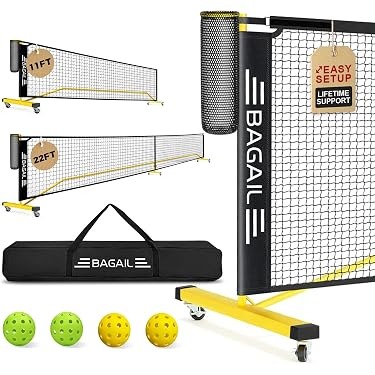
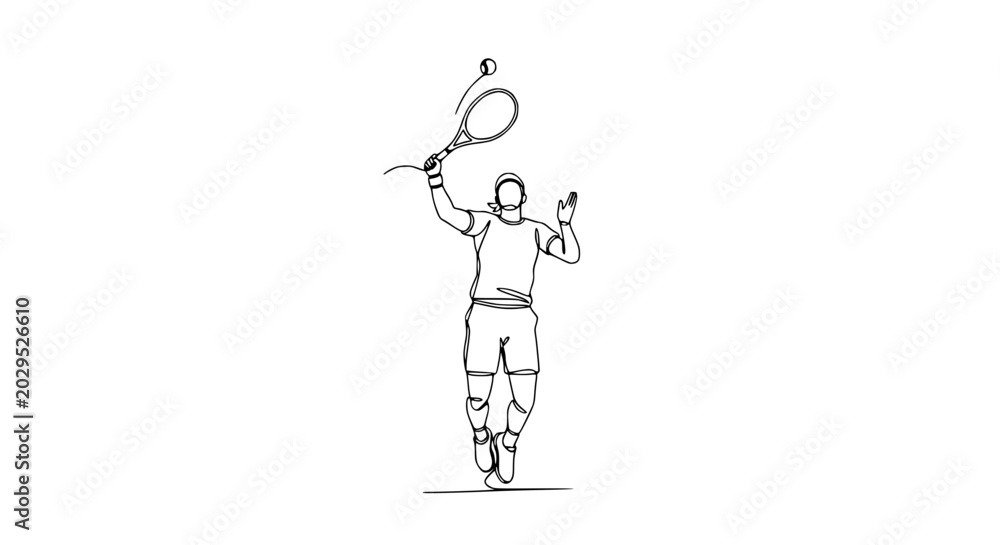
The regulation net is 3 feet (0.914 m) high at its center and 3 feet 6 inches (1.07 m) at the supporting posts. On a doubles net, the center of each post sits 3 feet outside the doubles sideline. To play singles on that net, place singles sticks with their centers 3 feet outside the singles sidelines. A dedicated singles net puts its post centers 3 feet outside the singles sidelines.
Playing Court vs. Total Space: How Much Run-Off Is Recommended?
Players need room beyond the baselines to retreat for deep shots and beyond the sidelines to reach wide ones. Appendix X of the ITF rules recommends run-off for club play and for international competition.
| Context | Total rectangle | Behind each baseline | Outside each doubles sideline | Total area |
|---|---|---|---|---|
| Marked doubles playing court | 78 × 36 ft | Not included | Not included | 2,808 sq ft |
| Club and recreational recommendation | 114 × 56 ft | 18 ft | 10 ft | 6,384 sq ft |
| International competition recommendation | 120 × 60 ft | 21 ft | 12 ft | 7,200 sq ft |
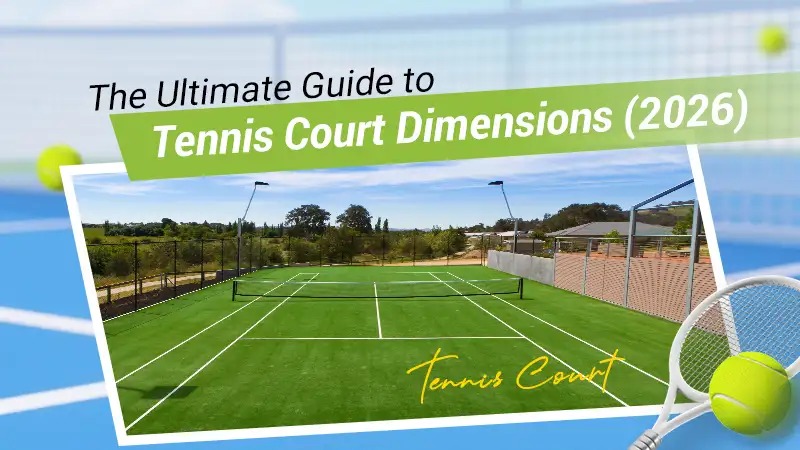
Limited room behind a baseline changes how you play. A league player described a court where a back fence kept getting in the way:
I play in a team league where 3 courts are required for a match. A new club recently joined the league, and one of their courts, which I think was newly built so they could enter a 3-court league, is very dubious due to the amount of space they had available. The court itself is regulation size, but there is almost no space at all behind the baseline at either end - the distance between the baseline and back fence is about equivalent to the width of the doubles lines, so about 5 feet - and if you're standing on the baseline you will often hit the back fence with your backswing. I played there once, and more than a few times I crashed into the fence while chasing a ball that was barely over the baseline, becuase I'm used to having more room. I ended up having to play in an artificial way to avoid collisions since it was basically impossible to move behind the baseline to return deep balls without hitting the fence.
Measure from each baseline to the back fence and from each doubles sideline to the side fence, then check the results against the table.
When Do Standard Court Dimensions Not Apply?

Some authorized junior formats use reduced courts. ITF Appendix VIII recognizes modified layouts for certain under-10 play.
A USTA educational guide published in 2017 illustrates red courts measuring 36 × 18 feet and orange courts measuring 60 × 21 or 60 × 27 feet. The same guide includes full-length 78-foot green and yellow formats.
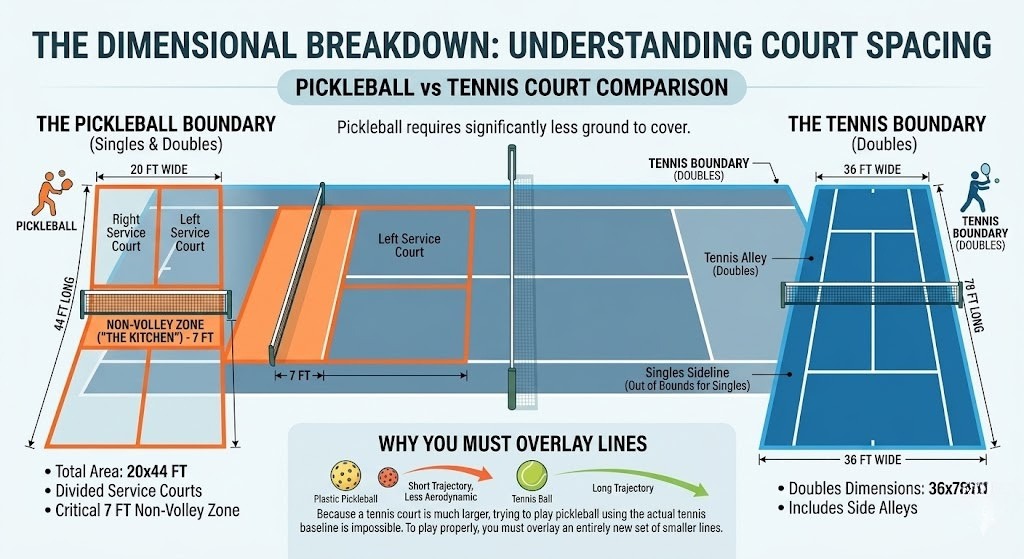
On a shared tennis and pickleball surface, extra painted lines mark the other sport's boundaries. Ignore them for tennis.