
In a rally, the inner singles sidelines count in singles and the outer doubles sidelines count in doubles. A serve in either format must land in the diagonally opposite service box, and a serve that lands in the doubles alley is a fault. A ball touching the line that applies to the shot is in, so first decide whether it was a serve or a rally ball, then find that line.
| Shot | Format | Valid landing area | Doubles alley in? | Lines that count |
|---|---|---|---|---|
| Rally | Singles | Singles court | No | Singles sidelines / baseline |
| Rally | Doubles | Doubles court | Yes | Doubles sidelines / baseline |
| Serve | Singles | Diagonal service box | No | Singles sideline and center service line / service line |
| Serve | Doubles | Diagonal service box | No | Singles sideline and center service line / service line |
The extra alley width matters during doubles rallies. The receiving service box stays the same size in both formats.
What Are the Lines and Areas on a Tennis Court?

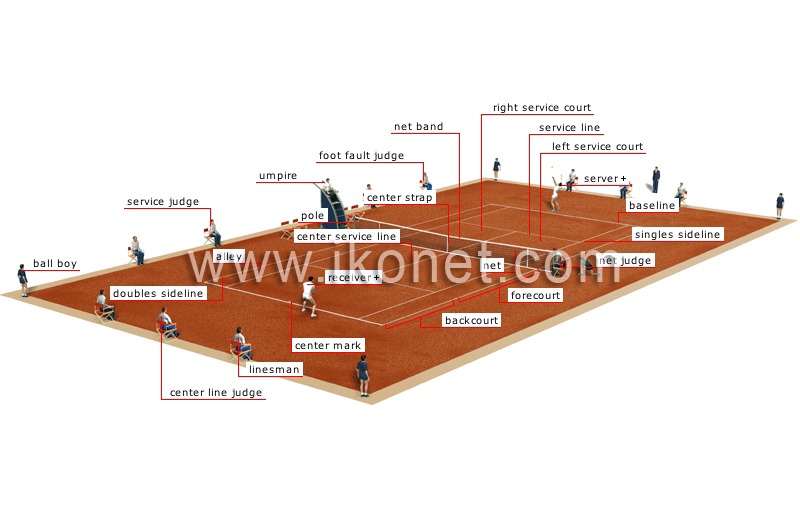
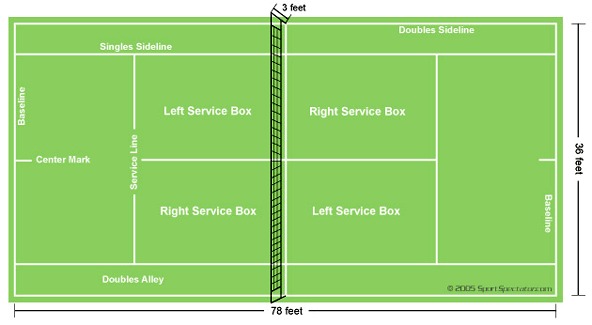
A regulation tennis court is 78 feet (23.77 meters) long. The singles court is 27 feet (8.23 meters) wide; the doubles court extends to 36 feet (10.97 meters).
- Baselines and center marks: A baseline runs across each end of the court. Its center mark is a 4-inch (10 cm) tick that helps orient the server.
- Singles and doubles sidelines: The inner line marks the singles width, and the outer line marks the doubles width. The strip between them is the doubles alley, 4 feet 6 inches (1.37 meters) wide on each side.
- Service lines and center service line: Each service line is 21 feet (6.40 meters) from the net and runs between the singles sidelines. The center service line divides the area near the net into two receiving service boxes on each side.
Don't confuse the center mark with the center service line. The mark is a short tick on the baseline; the center service line separates the two service boxes nearer the net.
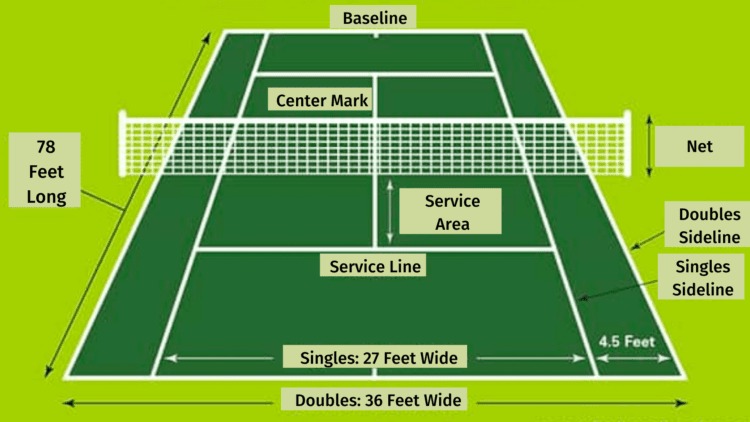
These measurements describe a full-size court; modified courts for some young players use different layouts.
Measurement and construction questions have their own page: regulation tennis court dimensions.
Which Lines Count in Singles and Doubles?
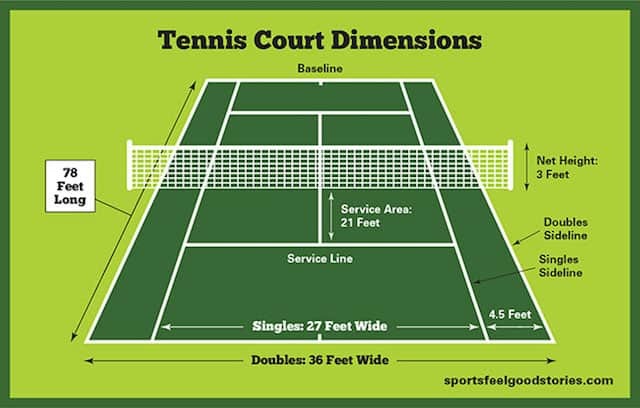
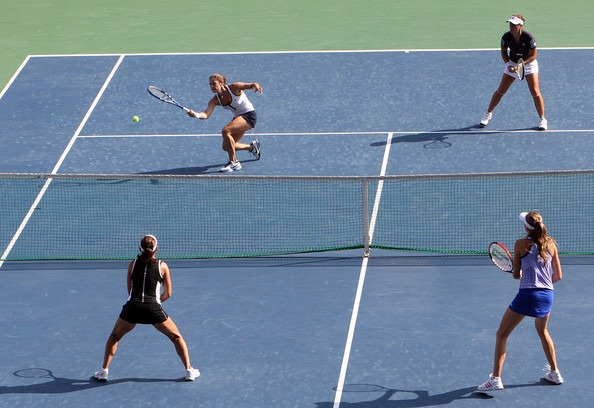
Singles rallies use the inner singles sidelines and baselines. Doubles rallies use the outer doubles sidelines and baselines, so both alleys are in play.
Picture a return whose first bounce lands two feet into the doubles alley, beyond the singles sideline but inside the doubles sideline. It is out in singles and in during a doubles rally.
Once the serve has been returned, the service lines no longer limit a rally shot, so a rally ball can land inside a service box without being a fault. Across the court, the two alleys add 9 feet to the doubles rally width.
Service order and match structure are covered in the guide to singles and doubles rules.
Where Must a Tennis Serve Land?
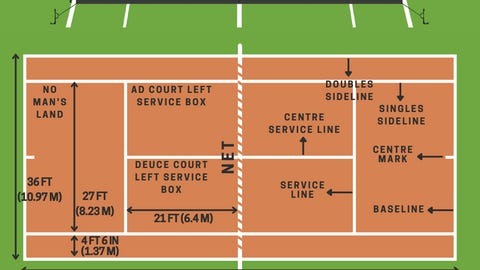
Every ordinary serve must land in the diagonally opposite service box, in singles and doubles alike.
You start a standard game on the right, or deuce, side as you face the net, serving from behind the baseline diagonally into the receiver's service box. On the next point you move to the left, or ad, side and serve to the other diagonal box.
The receiving box is bounded at the back by the service line, at the inner side by the center service line, and at the outer side by the singles sideline. The net marks its near edge, and net contact falls under separate service rules.
- Good: A serve that first lands on the proper service line, the center service line or the singles sideline is in.
- Fault: A serve that first lands in the doubles alley is out, even in doubles.
- Long: A serve whose first bounce is near the baseline has gone past the service line.

A foot fault is a separate fault from a bad landing. After a legal return, the rally sidelines decide every later shot.
Other service requirements are in tennis serving rules.
Is a Ball That Touches the Line In?
Yes, when it touches a line bounding the court that applies to the shot. ITF Rule 12 treats contact with that boundary line as contact with the court itself.
A singles rally ball clipping the inner sideline is in. In doubles, the same applies to the outer doubles sideline. On a serve, a first bounce on a service-box line is good. An outer doubles sideline still lies outside the singles rally court.
One fan at Indian Wells put it this way:
I recently watched several matches at Indian Wells that used auto line calling. On many points, I was convinced the ball was out, and it seemed like the crowd and sometimes even the players thought the same, yet the call was in. It made me wonder whether most of us have a fundamentally flawed sense of what is actually in or out. In a rec match, I probably would have called many of those balls out.
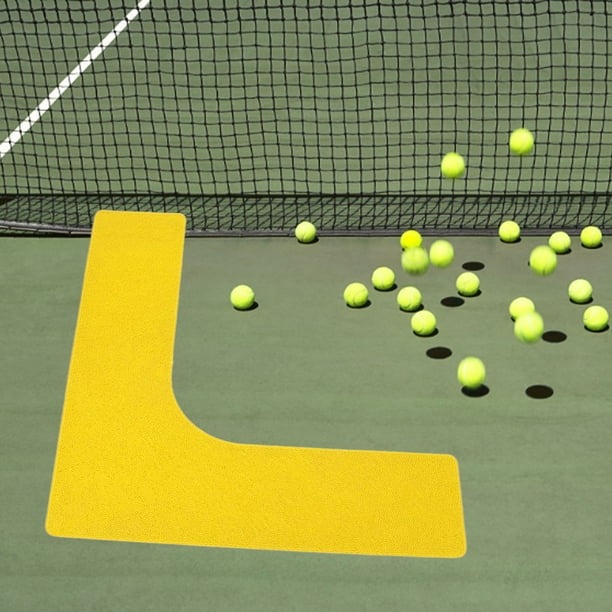
If the video doesn't show where the ball touched, nobody can call it.
Can You Stand Behind the Doubles Alley to Serve?
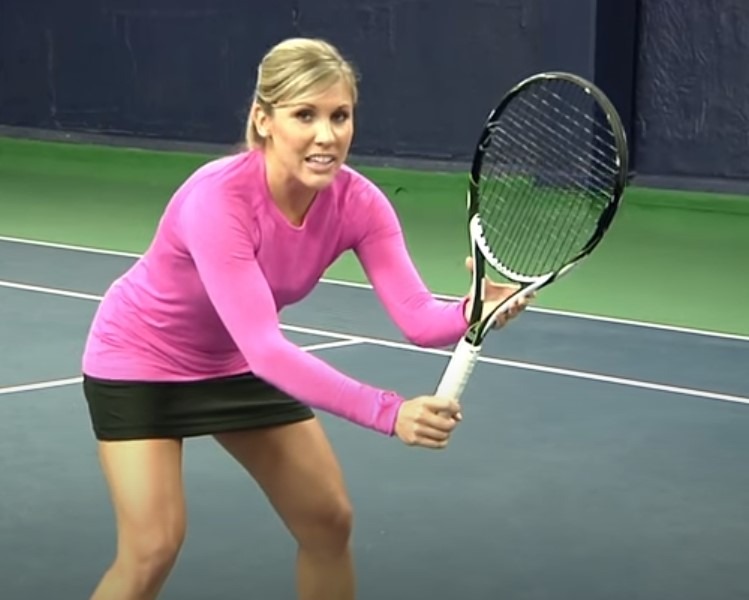
In doubles, Rule 18, Case 1 allows a server to stand behind the baseline in the extension of the doubles alley; singles servers can't stand there. Just before the service motion, both feet must be at rest behind the baseline, between the imaginary extensions of the center mark and the applicable sideline. During the motion, neither foot may touch the baseline or court, the center-mark extension, or the area outside the sideline extension. You may not change position by walking or running, though slight foot movements are permitted. The serve still has to land in the diagonally opposite service box.
Who Calls the Lines in a Recreational Tennis Match?
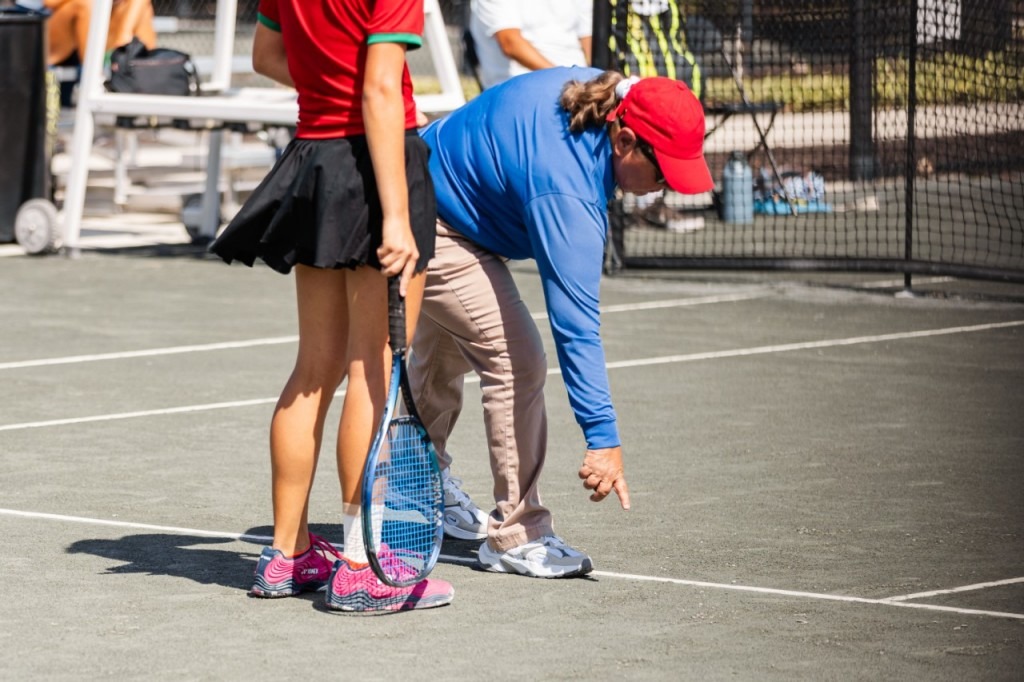
In an unofficiated match, players call balls on their own side of the net. Under the USTA's 2026 Friend at Court, The Code tells players to give opponents the benefit of any doubt on a close call. Doubt alone is not grounds for replaying a point.
One recreational player asked about this exact situation:
I'm in my second summer of match play and always try to give my opponent the benefit of the doubt on line calls - if I I'm not sure if it's out, I call it in. However as I've played more, I've noticed a few times where I played a first serve that is borderline, I'll continue to play the point and catch my opponent by surprise. They'll say something like "are you sure that was in?" after the point and I wonder if I got it wrong. I've also seen serves of my own that look clearly out (typically long) and people play it out and I feel guilty getting the point. What's the etiquette on this?
The Code prevents the serving team from calling its own first serve a fault. If the receiver plays a first serve that was a fault but fails to put the return in play, the server or partner may call the fault. The serving team must call a second serve that either member clearly sees out.
In doubles, the receiver's partner should call the service line, while the receiver should call the sideline and center service line; either may call a ball they clearly see. If partners disagree about a call, the opponents get the favorable decision.
Before an unofficiated doubles match, make sure both receiving partners know who covers which line under The Code. Where officials are assigned certain calls, their match procedures decide those. Detailed disputes are covered in tennis line calls.
Try These Court-Line Calls: Six Situations

Cover the Call and Reason columns, decide the call, then check your answer. The first five rows assume a first bounce from an otherwise legal shot.
| Shot | Format | First bounce or observation | Applicable boundary | Call | Reason |
|---|---|---|---|---|---|
| Rally | Singles | Entirely in doubles alley | Singles sideline | Out | The ball passed the singles boundary. |
| Rally | Doubles | Inside doubles alley | Doubles sideline | In | The alley is part of the doubles court. |
| Serve | Doubles | Lands in doubles alley | Singles sideline | Fault | The alley is beyond the service box's outer singles sideline. |
| Serve | Either | Touches proper service line or center service line | Receiving service-box boundary | In | The ball touched a line that bounds the box. |
| Rally | Either | Clips active baseline on first bounce | Baseline | In | The baseline bounds the rally court. |
| Disputed video | Unspecified | Contact point not established | Depends on shot and format | Can't call it | The video doesn't show where the ball touched. |
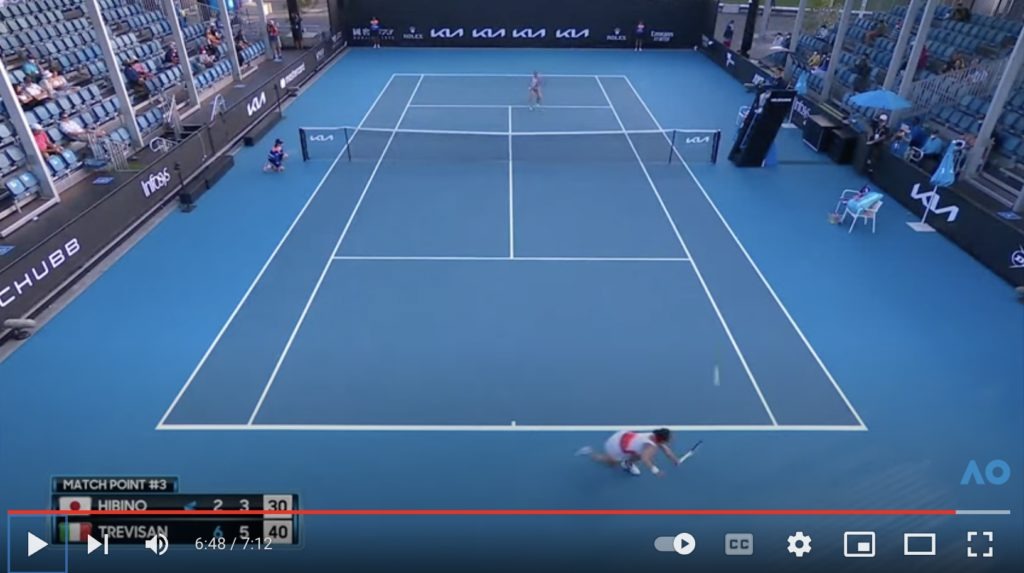
One player took a disputed match point online:
My buddy and I were on match point contrary to what the app shows. I asked two friends who are both tennis coaches (former D1 players). One said in, one said out. So I turn to the internet. What do you all think - in or out?