
Your NTRP level and rating letter, shown in your USTA account, decide which adult league divisions you can enter. If you have no valid rating, self-rate through USTA. A year-end change, an expired rating or an appeal can change your options, so check the current rules before you register.
What an NTRP Rating Means
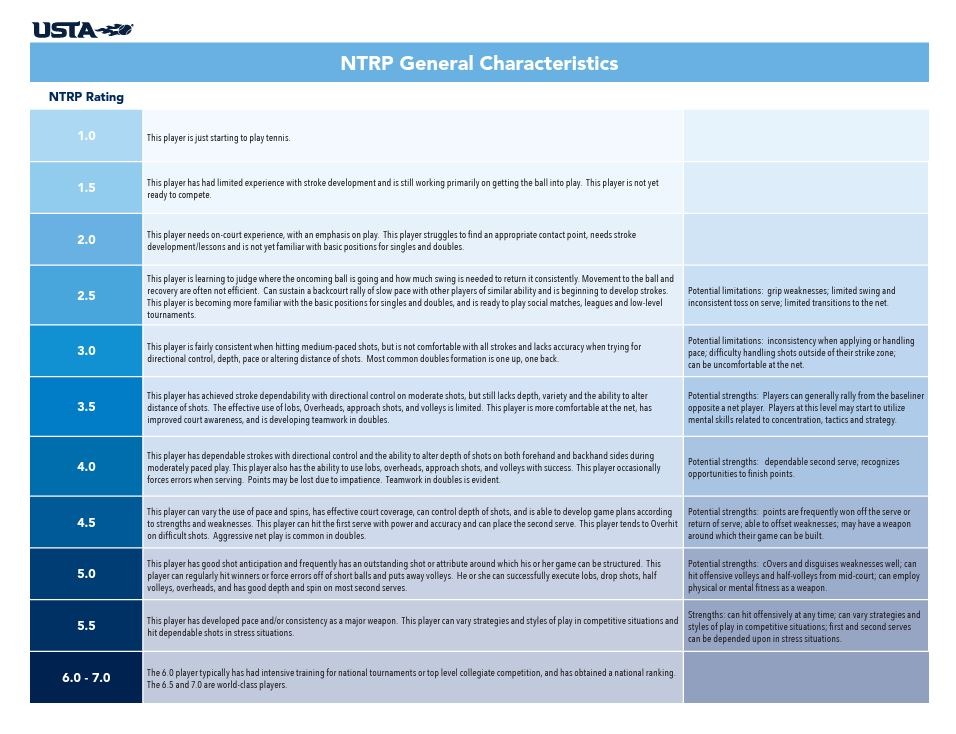
NTRP stands for National Tennis Rating Program. The United States Tennis Association (USTA) uses this scale to group players by general playing ability, so you face opponents close to your own level.
The scale runs from 1.5 to 7.0 in half-point steps. USTA Adult League divisions cover 2.5 through 5.0, and the programs available depend on your location. A ranking is a different thing: it orders competitors within a particular competition or ranking system.
What do 2.5, 3.0, 3.5 and 4.0 look like?
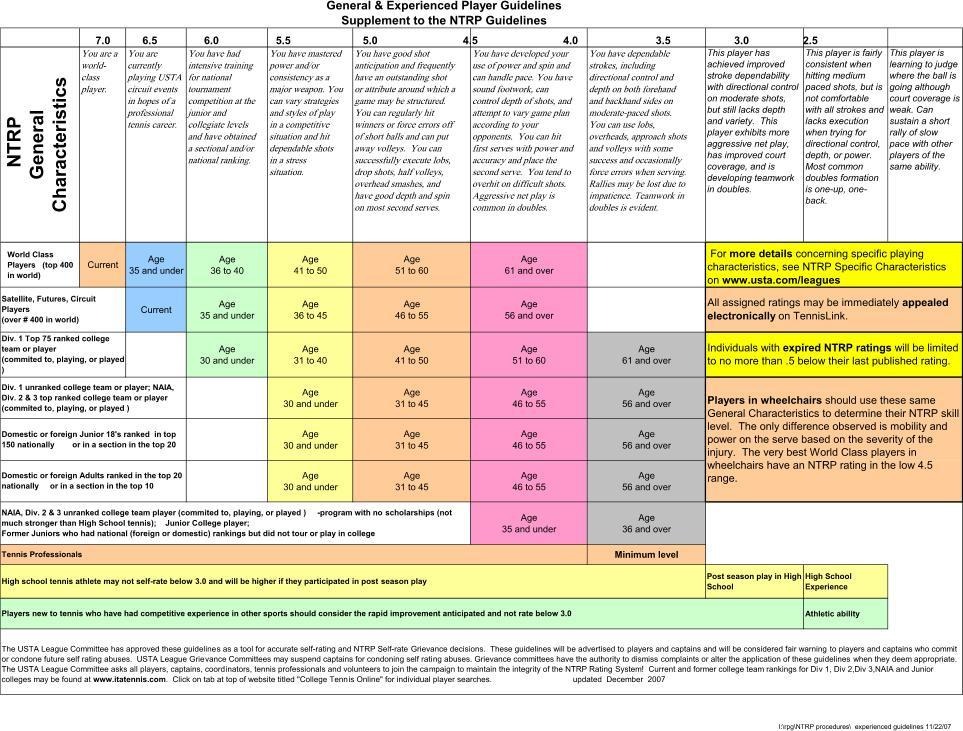
USTA's level descriptions show the strokes and decisions players typically handle at each stage.
| NTRP level | Typical ability | Developing skill |
|---|---|---|
| 2.5 | Beginning to rally on slower balls and develop recognizable strokes. | Movement, consistency and court positioning. |
| 3.0 | Greater consistency on medium-paced shots. | Controlling direction and depth; getting comfortable at net. |
| 3.5 | More dependable directional control on moderate balls. | Depth, variety, transitions and doubles teamwork. |
| 4.0 | More dependable placement and depth, with usable volleys, lobs and overheads. | Point construction under more demanding conditions. |
You can be comfortable with groundstrokes and still struggle with a volley.
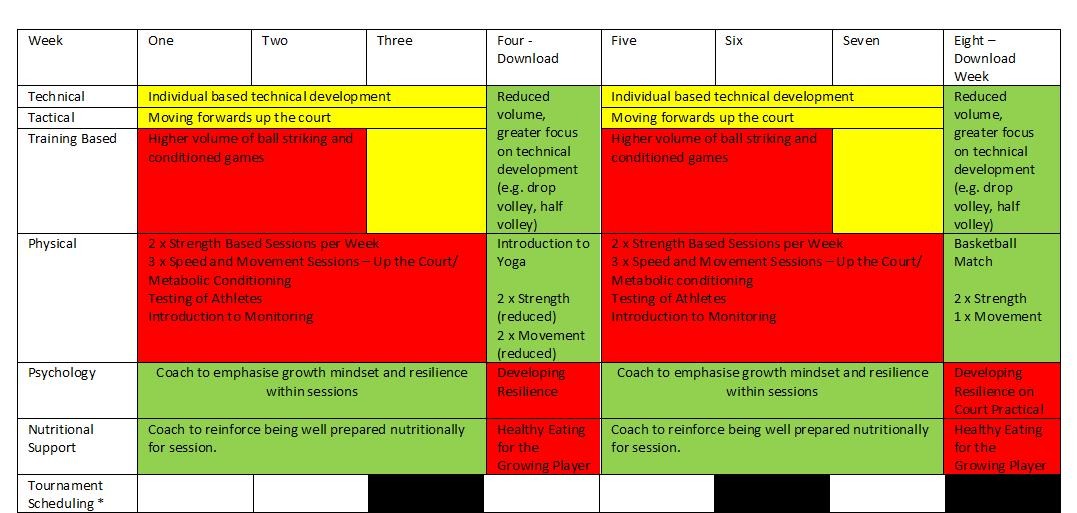
USTA's NTRP ratings FAQ gives 3.01 to 3.50 as the underlying dynamic-rating range behind a published 3.5. Players with the same public level can therefore differ in ability.
Self-Rated, Computer-Rated, Dynamic, and Year-End Ratings
A displayed rating has two parts: the level, such as 3.5, and often a letter that shows the rating's type or origin. For example, 3.5S comes from the self-rating process, and 3.5C is a computer-generated year-end rating based on qualifying play.
| Letter | Rating type | What it indicates |
|---|---|---|
| S | Self-rated | Entry level set by the questionnaire. |
| C | Computer-rated | Year-end rating calculated from qualifying results. |
| A | Appealed | Rating set through an applicable appeal process. |
| M | Mixed-exclusive | Rating derived through qualifying mixed doubles play. |
| T | Tournament-exclusive | Rating derived through qualifying tournament play. |
| D | Disqualified | Can follow a dynamic NTRP disqualification or an upheld NTRP grievance; the resulting rating affects league eligibility. |
Read the letter before you register. M, T, A and D ratings have their own rules for some USTA Adult League formats, and they can affect your eligibility.

The dynamic rating is USTA's internal calculation, carried to hundredths. It can change after eligible results, but USTA does not publish the value. The year-end rating is the public half-point level released after qualifying play, and it applies to the next relevant league season. Both terms describe how ratings are calculated and published, so neither appears among the six letters above.
Self-rating gives you an official starting level from the questionnaire. No computer-calculated decimal sits behind an S rating at that point.
How to Find Your Official Rating or Self-Rate
To see your published NTRP level, sign in at USTA.com, open Profile, then go to Personal Info and About. USTA's player-profile rating instructions document the route.
If the profile says Not Set, you may need a self-rating for adult league play. USTA's profile self-rate guidance points to the Self-Rate Form in the same account area.
- First-time adult player: Complete the official questionnaire if you have no applicable rating. Report your tennis experience accurately, including any competitive history.
- Returning player: Check whether your earlier computer rating is still valid for the season you want to play before you start a new questionnaire.
- Player with a valid C rating: Your C rating is your league rating. You don't need a new self-rating unless an exception for your rating category or competition applies.

If you return with a mixed-exclusive or tournament-exclusive history, you may need extra steps for Adult Division eligibility. For an unusual rating history or an unclear status, ask your USTA Section League Coordinator.
How NTRP Ratings Change After Matches
USTA compares your actual match scores with the results expected from the ratings of everyone involved. In doubles, that includes your partner and your opponents.
Consider two wins. One player is expected to win comfortably but finishes a close match. Another faces an opponent expected to offer an even contest and wins decisively. The two results tell the rating system different things, because it weighs score against expectation.
Wins and losses are visible, but USTA's method uses more than the final outcome. The formula is not published, so you cannot predict exactly how one result moves your dynamic decimal.
Which matches contribute to a year-end rating?
USTA's NTRP FAQ specifies at least three valid matches for a year-end computer rating. A valid match requires at least six completed games.

Whether a result qualifies also depends on the league, tournament or other eligible competition category. Practice sessions and results from other rating systems do not count automatically.
What a Year-End Rating Change Means for Next Season
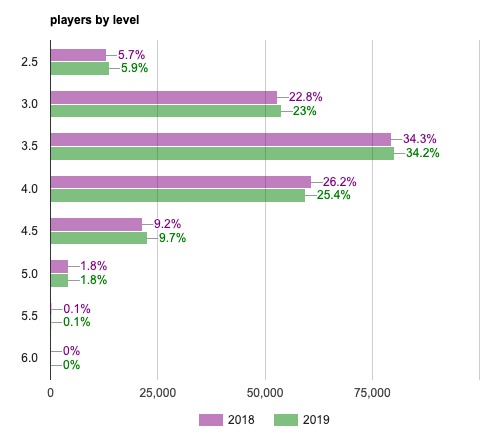
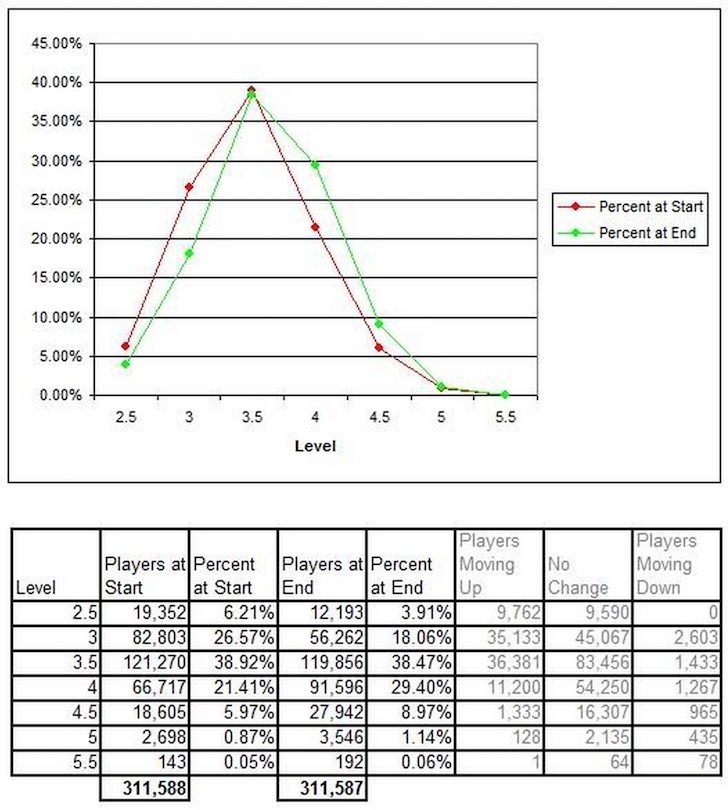
Moving from 3.0 to 2.5, or from 3.5 to 4.0, sets the level you take into the next USTA League season. It also decides which divisions will take you.
One recreational player described feeling discouraged after a year-end drop despite continuing lessons and physical training:
I just got my new NTRP rating. I went from a 3.0 to a 2.5. It just sucks and I feel really bad about myself. I've been taking private lessons, playing, running, weight lifting, all of it. My record is piss poor in my women's doubles leagues and I feel like it's created a chain effect that has completely killed my rating. This is where it sounds like I'm making excuses. I started on a 2.5 women's team where I was the youngest by a lot (I'm 35). I was the only one on the court who could run down a ball. I figure, no problem. I get bumped up last year after a good mixed doubles season.
- Playing up: Some leagues let you join a division above your rating, subject to roster and competition rules.
- Combined-level competition: Certain formats accept teams whose members have different NTRP levels within set limits.
- Other opportunities: A division you qualify for can still have a full roster. NTRP tournaments and recreational leagues can offer matches when your preferred team has no place.

Does Your NTRP Rating Expire? 2026 Rules for Returning Players
A computer rating can remain valid for more than one league year. The December 17, 2025 edition of USTA's 2026 national regulations sets different publication-year limits for players aged 59 or younger and players aged 60 or older during the 2026 league year.
| Most recent C rating issued | Age 59 or younger in 2026 | Age 60 or older in 2026 |
|---|---|---|
| 2023 | Valid | Expired |
| 2024 | Valid | Valid |
| 2025 | Valid | Valid |
A self-rating follows a separate rule: it remains valid for two years from issue unless a dynamic or computer rating replaces it.
A 58-year-old whose last computer rating was issued in 2023 still has a valid rating in 2026. A 61-year-old with the same publication year does not.
These are 2026 national conditions. USTA's League Resources provides regulations for each league season, so use the season and rating category that apply to your entry.
When you self-rate after an expiration, your earlier competitive experience still counts, so you cannot simply choose a lower level.
Should You Appeal Your NTRP Rating?
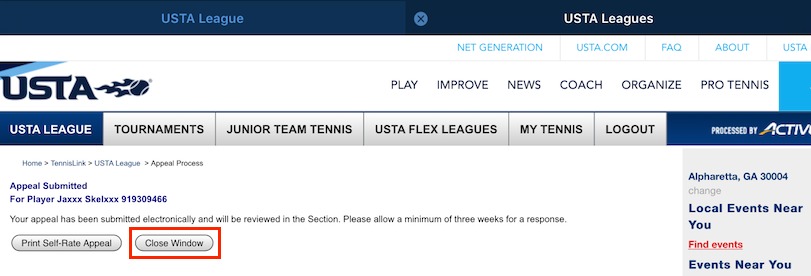
Appeal procedures depend on the kind of rating involved. A self-rate appeal addresses an initial questionnaire rating, and an automatic appeal addresses an eligible computer-generated year-end rating. Medical and other special appeals have additional requirements.
One returning recreational player ran into this after seeking a lower self-rating and finding that the club team they wanted was looking for someone at their original level:
I recently got back into playing as an adult. All of my playing experience is in my youth. I went on USTA’s website and made a profile when doing so I reiterated as a 3.0 but thought I should appeal and get rated down to 2.5. The team at my club who needs a player is a 3.0 team and needs a 3.0 player (have too many2.5 playing up). What are the chances of getting my rating changed back to 3.0 if I email/call and explain.
This request concerns a self-rating appeal. Under the 2026 regulations, the section's self-rate appeal committee makes a binding decision, with reconsideration permitted for a clear factual error.
For an automatic computer-rating appeal, USTA's NTRP appeal guidance warns that an approved automatic appeal cannot be reversed. After a denial, you cannot keep filing further automatic appeals. Some 2026 championship participation histories also restrict downward appeals.
Before you appeal, check your rating letter, confirm that the new rating would fit the division and roster you want, and read the eligibility rules for that appeal type, including the warning above.

What TennisRecord's NTRP Estimate Means

TennisRecord and similar services publish modeled rating estimates. USTA does not endorse third-party NTRP calculations and will not consider them as evidence in NTRP appeals or grievances. If an outside site estimates 3.47 while your USTA profile says 3.5C, your official 3.5C is the rating used for USTA league eligibility.
Choosing Your Next USTA Playing Option

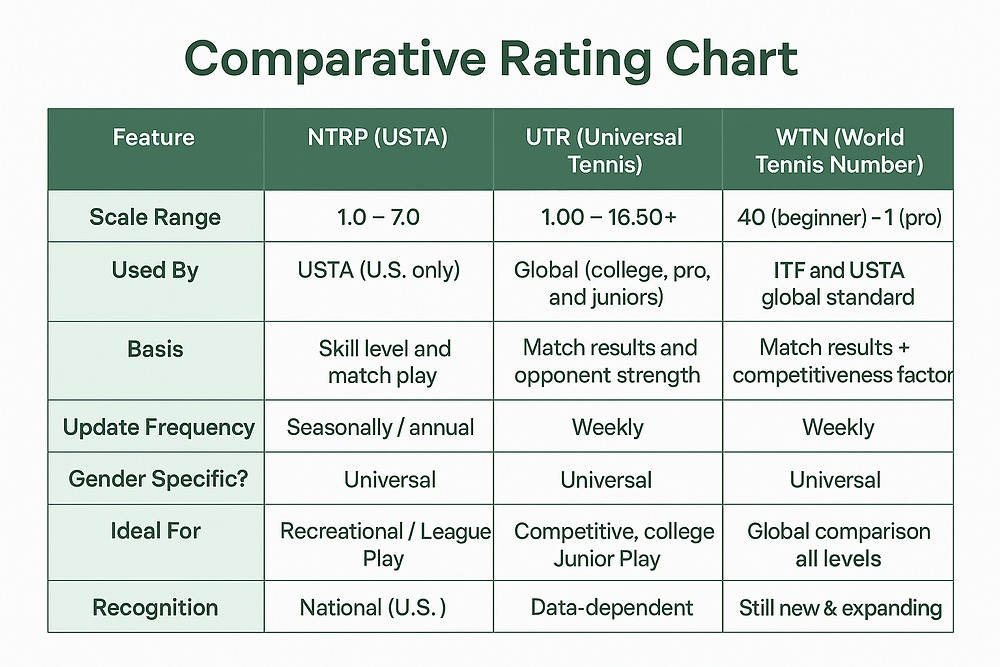
A valid NTRP rating determines which USTA Adult League divisions you can enter. USTA Adult League uses NTRP, and World Tennis Number is a different rating system.