
Start with the terms that decide the next point: score calls, serve calls and court sides. Pick up stroke names and club slang as you hear them. The table below covers the basics.
Tennis terms beginners should learn first
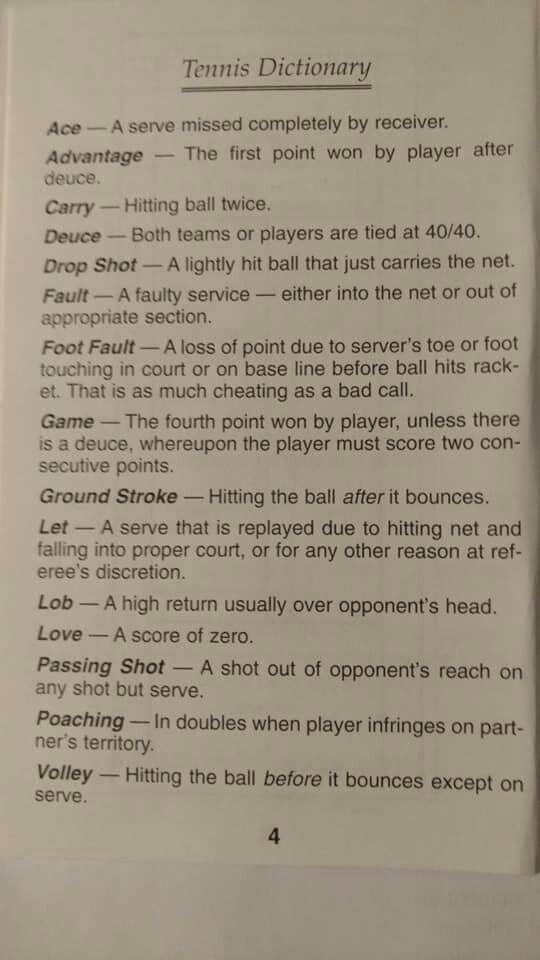
When a doubles partner calls “ad court” or someone announces “love-fifteen,” a quick definition is enough to keep playing.
| Term | Kind of word | Meaning | Example or detail |
|---|---|---|---|
| Point | Score | One scoring unit within a game | Points at stake |
| Game | Score | A sequence of points within a set | Points at stake |
| Set | Score | A sequence of games within a match | Points at stake |
| Match | Score | The full contest, played in an agreed set format | Points at stake |
| Love | Score | Zero | Score calls |
| Deuce | Score | 40-40 in advantage scoring | Score calls |
| Fault | Serve call | A service attempt that fails | Serve calls |
| Let | Rule call | A serve or point that must be replayed | Serve calls |
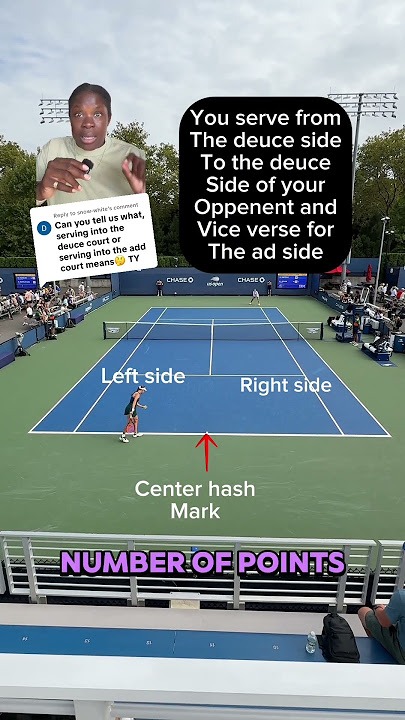
| Deuce court | Location | Right half of your end facing the net | Court positions |
| Ad court | Location | Left half of your end facing the net | Court positions |
| Volley | Stroke | A shot hit before the ball bounces | Shot names |
| Break point | Point stakes | Receiver can win the server's game on the next point | Points at stake |
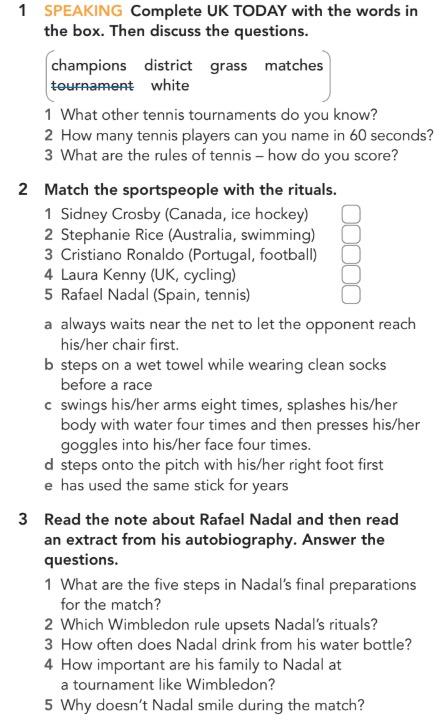
Jump to score calls, court words, serve calls, shots, match statistics or club slang. The ITF tennis glossary lists more terms.
How tennis scores are called: love, deuce and advantage
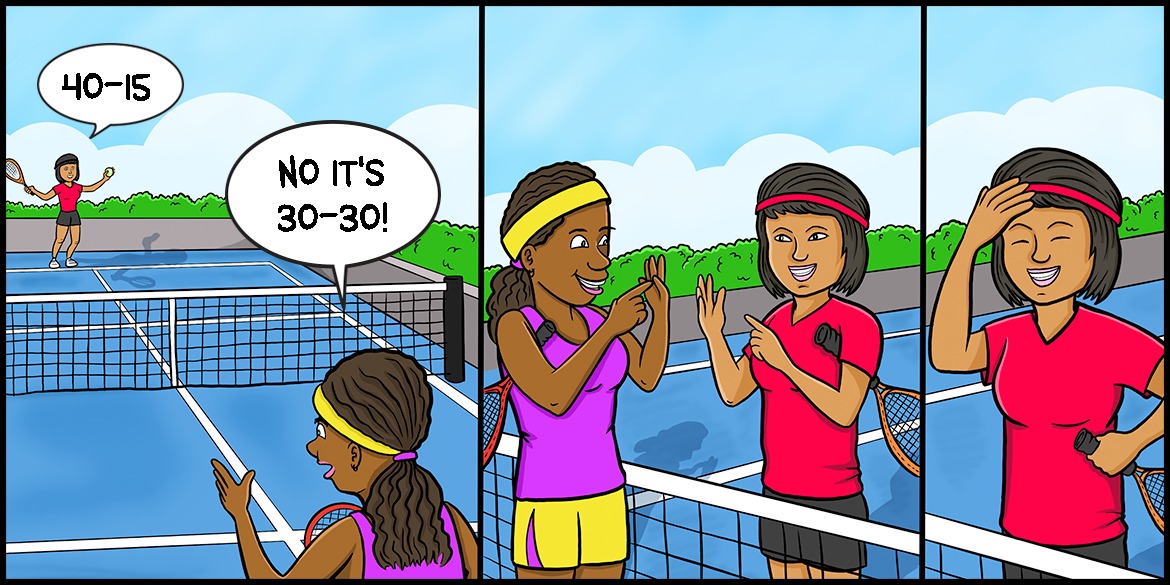
The server puts the ball into play with a serve; the receiver returns it. The server's point score comes first. “Fifteen-love” means the server has won one point and the receiver has won none; “love-fifteen” means the receiver won the first point.
The spoken sequence is love for zero, then fifteen, thirty and forty. At tied scores, you'll hear “fifteen-all” or “thirty-all.” At 40-40 in traditional advantage scoring, the call is deuce. The next point gives one player the advantage: ad-in when it's the server and ad-out when it's the receiver.
Ad-in is a score. The ad court is the left side of your end of the court. A no-ad game uses a deciding point instead, so the advantage sequence does not apply. A tiebreak is a separate scoring sequence within a set, with points counted numerically. The USTA tennis-terms guide defines the American terms.
Some players say “five” for “fifteen” (one r/10s poster complained about it in March 2026). If you can't tell the score, ask for the full call.
Game point, break point, set point and match point
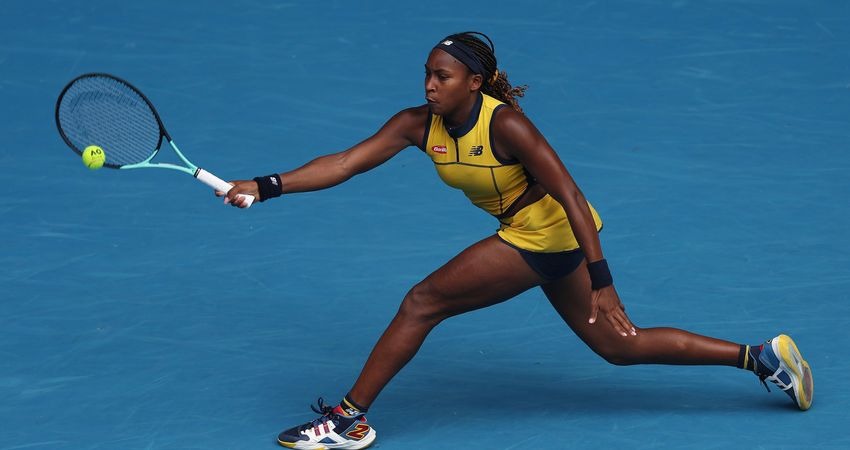
These expressions name what a player wins with the next point.
- Game point: The player can win the game on the next point.
- Break point: The receiving player can win the server's game on the next point.
- Set point: The player can win the set on the next point.
- Match point: The player can win the match on the next point.
- Break of serve: The receiver wins the opponent's service game.
- Hold serve: The server wins their own service game.
Say the server trails 30-40 in an advantage-scoring game. The receiver has break point: one more point wins the server's game. It is also game point for the receiver, and set point if that game ends the set.
Court words: deuce side, ad side, alley and service box
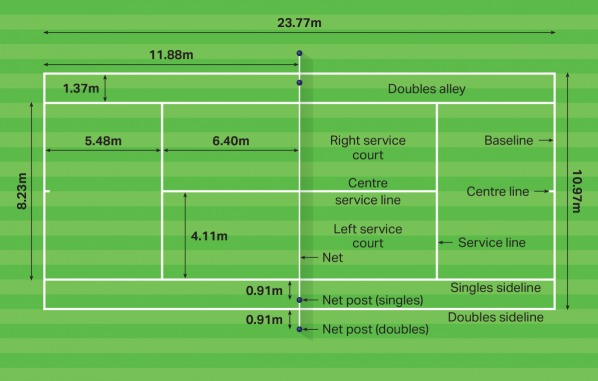
Face the net from your end of the court. Your deuce court is on the right; your ad court is on the left. A doubles partner who says “I'll receive in the ad court” is naming a court location.
- Baseline: The line across the back of the court.
- Sideline: A side boundary; singles and doubles have different outer boundaries.
- Alley: The strip between the singles and doubles sidelines, also called the tramlines.
- Service box: The diagonally opposite area where a serve must land.
- Service line: The line at the back of the service boxes, nearer the net than the baseline.
- Center service line: The line dividing the service boxes on each side of the net.
- No-man's-land: An informal name for the area between the service line and baseline.
Serve calls: fault, double fault, service let and a let during play
A fault is a serve that misses. A let is a replay, of either the serve or the whole point, depending on what happened.
| What happened | Term | Consequence |
|---|---|---|
| First service attempt fails | Fault | The server gets a second attempt. |
| Second service attempt also fails | Double fault | The server loses the point. |
| A serve touches the net and otherwise meets the service-let conditions | Service let | The serve is replayed. |
| Play is interrupted during a rally | Let during play | The point is replayed. |
A ball rolling in from another court during a rally is a let during play. A foot fault is called for the server's foot position or movement, as set by the serving rules.
For a stray ball from another court, USTA's guidance says the affected player should call a let promptly once aware of it. A claim made after an unreasonable delay or after the point has ended is invalid.
One player hit a clean winner, and the opponent then claimed a let:
So the situation is a follows: during a point, I played a slice short cross court to my opponent's backhand (ad) side of the court. He got to it, but played a weak shot back down the middle. He is now out of position and I step in and hit a clean winner to the open (deuce side) court. However, after I hit my shot my opponent claimed a let, because he had been distracted by a ball from another court that had rolled behind me near the back fence, as or just before I took my last shot. I felt that was unfair because imo there was no way he would have got to my shot anyway. Also, surely he should have made the call before I took my shot?
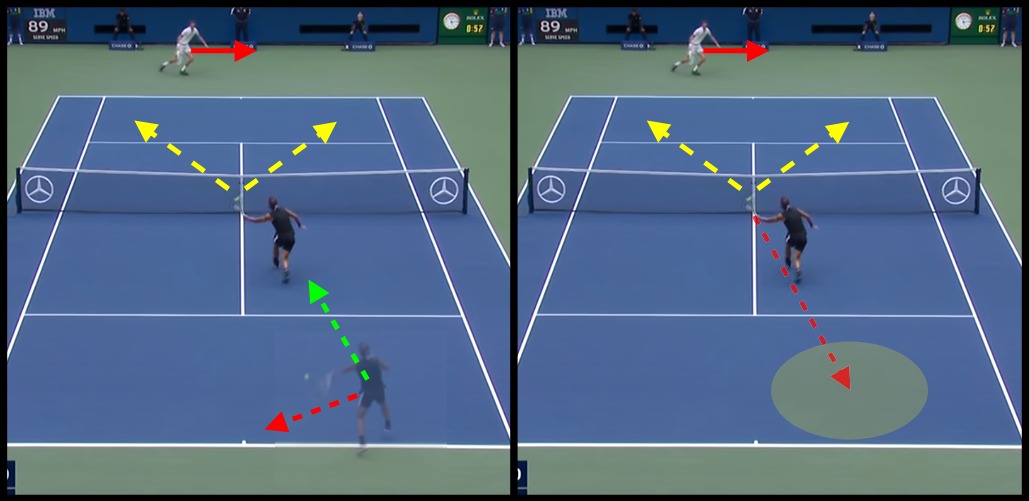
The post doesn't say when the opponent noticed the stray ball.
Shot words: forehand, backhand, volley, slice, lob and drop shot
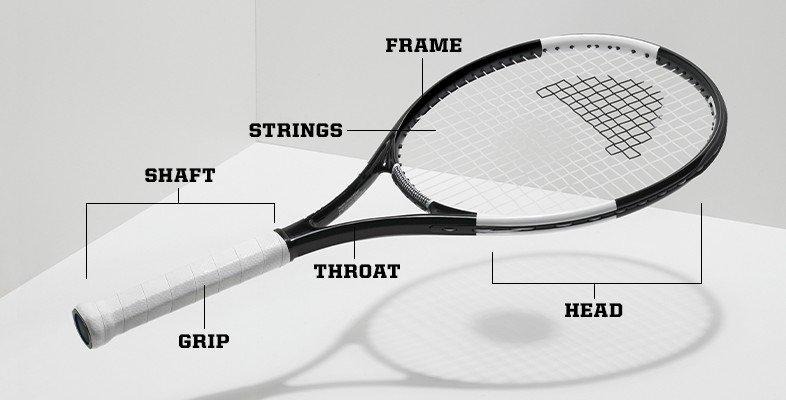
For a right-handed player, a forehand is played on the right side and a backhand on the left; those sides reverse for a left-handed player.
| Shot | What you recognize | On-court example |
|---|---|---|
| Groundstroke | The ball bounces before you hit it | Trading shots from the baseline |
| Volley | You hit the ball before it bounces | Intercepting a ball at the net |
| Lob | The ball travels in a high arc | A shot that goes over a player at the net |
| Drop shot | The ball lands short near the net | A shot that pulls your opponent forward |
| Half-volley | The racket meets the ball just after its bounce | Picking up a low ball as it rises |
Topspin is forward rotation of the ball. A slice is a cut that produces backspin or underspin. In doubles, a poach is an interception by a player who moves across toward a ball normally played by the partner.
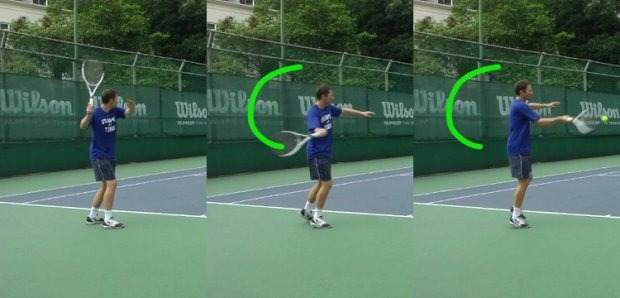
Match commentary: ace, winner, forced error and unforced error
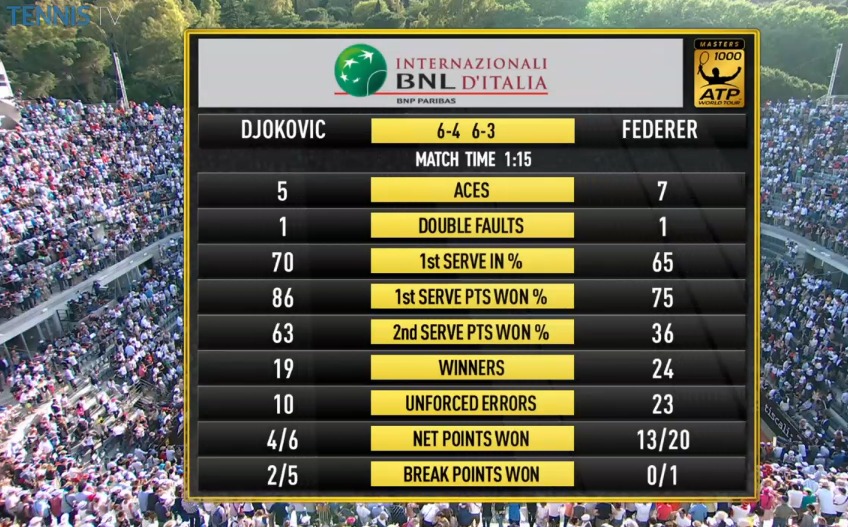
An ace is a serve that wins the point without the receiver touching it. In the LTA's match-statistics terminology, an unreturned serve is touched by the receiver but doesn't come back into court. A winner is a shot credited with winning the point outright because the opponent can't make a return. A forced error is a miss caused by pressure from an opponent's shot. An unforced error is a miss the scorer judges was not forced. Scorers can classify the same difficult ball differently.
Club slang: pusher, junk ball, moonballer, bagel and breadstick
A pusher is an informal label for someone who keeps returning balls and chooses low-risk shots. Depending on who says it, it either describes defensive play or insults the player.
A junk ball is a colloquial name for an awkward, off-pace or unconventional shot. A moonball is a high, looping ball, and a moonballer is a player known for that style.
A social-league player described how those labels sounded when an opponent got frustrated:
As she walked off the court she yelled at me, “You’re a pusher! You’re not playing real tennis!” Then to her teammates: “She’s just giving me junk balls! It’s not real tennis!” Then her sub came in and I won the next two games and won the set 6-3. I see people on this sub saying that they lost to “worse” players who were “pushers” and I wonder how many of those “worse” players had just figured out how to beat you. Last night I went in with a plan, I executed it, and I guess now I’m a pusher. Hey, if that’s being a pusher, I’ll wear that badge with pride.
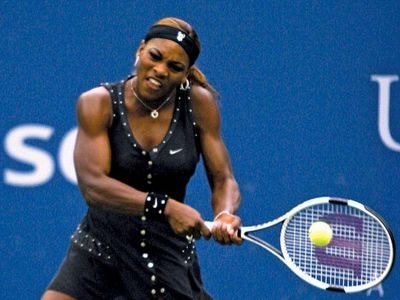
Two more informal terms name set scores: a bagel is a 6-0 set, and a breadstick is a 6-1 set.
Quick checks: what did they mean on court?
Read the first column, decide what the phrase means, then compare it with the second.
| What you hear or see | Meaning in context |
|---|---|
| “Ad-in.” | The server has the advantage. |
| “Take the ad court.” | Use the left half of your end while facing the net. |
| “Break point.” | The receiver can win the server's game on the next point. |
| The first serve misses. | It's a fault. The server has a second attempt. |
| A player hits the ball before the bounce. | That's a volley. |
| “That opponent is a pusher.” | It's an informal description of playing style. |