Try Australian when a repeatable crosscourt return is hurting your serving team and a same-side net player can challenge that lane. Try the I-formation when a central start can disguise the net player's direction and both partners can cover the resulting spaces. Stay standard if the switch disrupts the serve or leaves more court exposed, and rehearse the first movement before you use either variation in a match.
I-Formation vs. Australian Formation: What Changes?
The two formations give the returner different pictures before the serve. Australian moves the serving net player onto the server's court half. In the I-formation, that player crouches near the center service line, with their next move agreed before the serve.
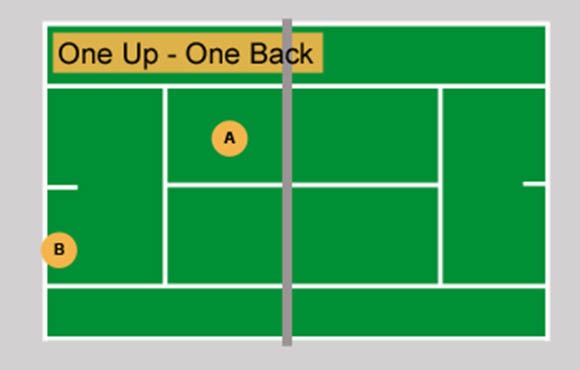
Standard doubles gives the pair a familiar starting point. With one player up and one back, the net player begins on the court half opposite the server.
| Formation | Where the serving net player starts | What changes for the returner | What the serving pair handles |
|---|---|---|---|
| Standard | Opposite half from the server | Familiar crosscourt and line options | Defend the usual lanes |
| Australian | Same half as the server | One familiar return lane is challenged | Server switches toward the other half after contact |
| I-formation | Low and centrally near the service line | Harder to tell which side the net player will take | Partners agree on the move or stay call |
If your return game is already fine, a new formation has to earn its place. Ask which shot the receiving team keeps hitting that your pair defends badly. For general coverage outside these two serving arrangements, see doubles positioning.
Start With the Return That Keeps Beating You
Change formation only when you can name the return it should disrupt. Watch the receiver's first ball on the relevant service side. Does it go deep crosscourt, down the line, over the net player's head, or into a channel your team already covers?
| Observed problem | Starting option | Deciding condition |
|---|---|---|
| Crosscourt return repeatedly bypasses the usual net position | Try Australian | The net partner can challenge that lane while the server covers the alternative |
| Returner reads a side-set net player before the serve | Try I | The net partner can move after the serve and the server can cover the other half |
| Down-the-line return reaches vacant court | Rethink the switch | The line still needs a defender |
| Serve errors occur before the returner can establish a pattern | Stay standard | A formation change does not fix the service motion |
Deuce and ad points put the returner in different receiving positions. Handedness, serve placement, and the returner's preferred contact point can change which lane is threatening.
A USTA 3.0 player lost to a team that kept returning inside-out crosscourt from the ad side, and wondered whether Australian was an option they had overlooked:
So second year playing USTA leagues (3.0) and I was wondering if people have doubles strategies to eke out wins when playing against a stronger or equally matched teams. e.g. We lost to a team in a superset yesterday, I felt the team were well matches (they were 2.94/2.81 in tennis record, we are 2.81/2.76). Some of my higher level friends commented about why we didn't try a Australian formation (both players on same side during serve) since they were always going inside out cross court on Ad side on my serve. I was wondering if there are other strategies that we can use and when to use them?
They hadn't tried the switch yet, but the problem was specific: the same ad-court channel, point after point.
One winner tells you little. A return that keeps finding the same lane is a reason to change your starting coverage.
When Australian Formation Is Worth Trying
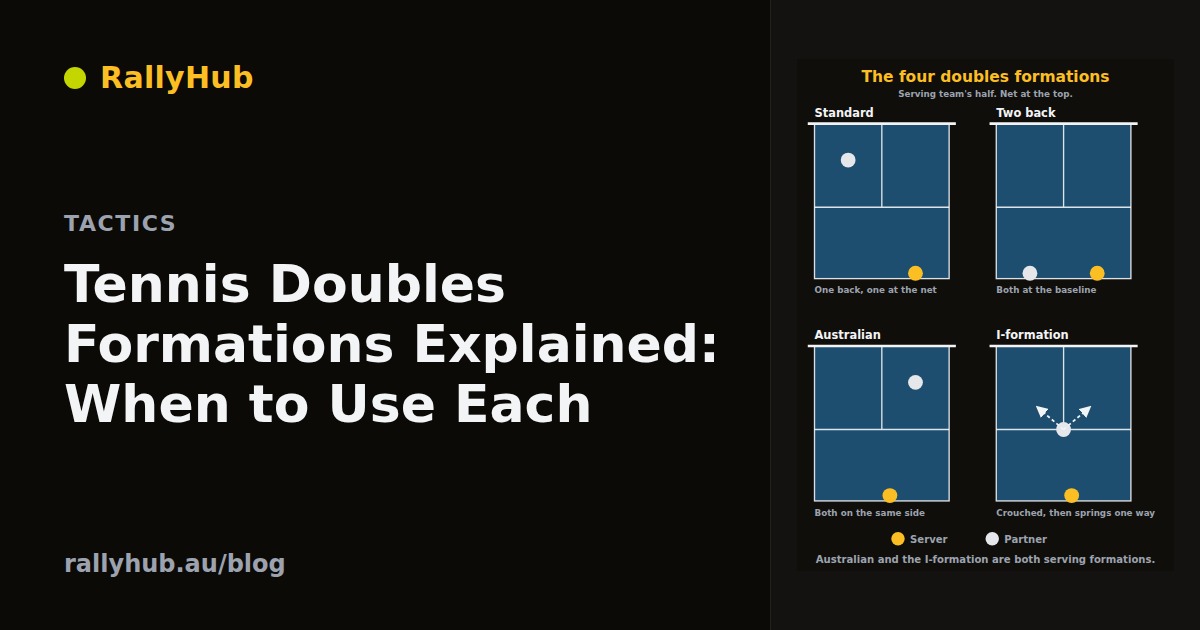
Try Australian against a returner whose crosscourt ball keeps passing the net player in standard position. Putting the net partner on the server's half changes the lane that player can threaten and forces the receiver to rethink the first shot.
On a deuce-court serve, the server serves legally from behind the deuce half of the baseline while the net partner starts on that same half near the net. The ad side mirrors this. The server may set up closer to the center mark while staying within the permitted service position. The USTA's Australian-formation instruction describes the changed net-player alignment.
After contact, the server switches toward the opposite half to cover the return down the line, while the net partner holds the chosen same-side lane. Timing and distance depend on the serve and the receiver. The legal serving side does not change.
An ad-court receiver who keeps driving an angled return toward the backhand side is a good reason to try it. The receiver may answer with a line return or a lob over the net player, so the server's recovery matters.
3.5/4.0 Level. Lost first set 4 6. I changed the strategy to Australian formation when my partner was serving from the add side on the 2nd set. Worked like a charm. Second set. 6 4. Third set ended at 3 0 cause we ran out of time. Highly suggest it if the opponent is very strong at returning deep shots/nice angles to the backhand and is winning the majority of the rallies (add returner).
That player reported turning around a set after changing the ad-court setup, with the final set abandoned for time.
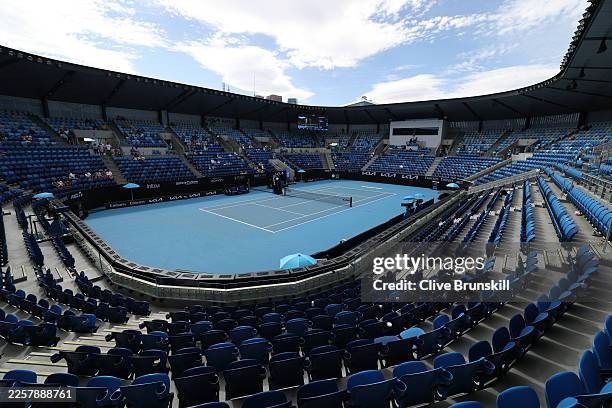
When the I-Formation Makes More Sense
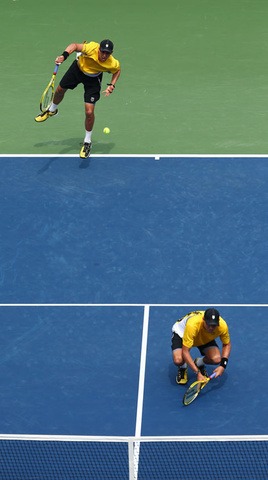
The I-formation gives the net partner a central starting point that hides the direction of the first move. It can trouble a returner who has learned to aim away from a predictable side-set net player.
In a basic I play, the net partner crouches low near the center service line before the serve, then breaks to the agreed left or right side after contact. The server moves toward the other space. Some calls have the net partner hold the middle, with the server's coverage assigned in advance.
This asks more of both partners. The net partner must be comfortable starting low and moving out of the server's path. The server needs a dependable serve and enough recovery time to defend the other half. The central start is pointless if the pair cannot run the call.
In a 2020 observational study of 1,067 points from 18 top-level men's doubles matches, the I-formation appeared on about 46% of first-serve points and 41% of second-serve points. Classical and I formations had similar observed efficiency in that sample. Those frequencies do not predict results for US recreational pairs.
Deuce and Ad Court: Where Each Player Starts
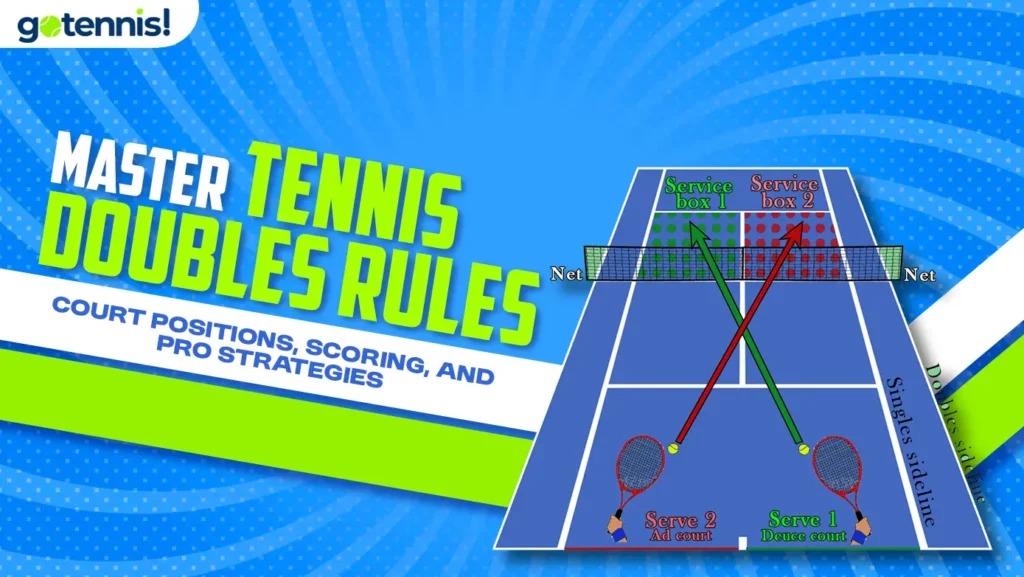
The diagonal receiving box changes with each service half. The server serves from behind the permitted baseline half, the returner receives from the matching diagonal side, and the returner's partner takes the receiving team's other position.
- Deuce-court serve: For Australian, the net partner begins on the server's half. For I, the net partner begins low near the center service line.
- Ad-court serve: Australian mirrors the deuce setup. I keeps the central start, with the intended movements specified for this side.
Judge every move from the server's viewpoint. Left stays left on both sides, but the returner receives from the other diagonal, so a line return takes a different path.
For I, the agreed net-player move or stay call decides the server's first coverage. For Australian, the server's switch after contact is already assigned, though the ball's actual direction may require another response once the return arrives.
The Pre-Serve Agreement: Who Moves Where?

The formation works only when both partners know what happens after the serve. Agree on a simple left, right, switch, or stay signal. Its meaning is whatever the two of you decide.
- Formation: Name standard, Australian, or I before the server begins the motion.
- Serve target: Agree on the intended legal receiving-box area, such as toward the T.
- Net-partner move: The net partner knows whether to stay or move left or right after contact.
- Server coverage: The server knows the other space to defend.
- Unexpected return: Both know who takes a ball through the middle or a lob that breaks the starting plan.
Suppose the net partner moves left while the server also heads left. The returner sends the next ball through the open right half. The plan failed, even though both first steps were quick.
Before each point, each player should be able to say their first direction and their initial coverage. If the two answers differ, use the standard positions for that point. More extensive calls belong in doubles communication and hand signals.
How Returners Can Counter Australian and I
Changing formation gives the returner a different first-ball problem. It can also open another route: the line behind a same-side net player, the court a moving partner vacated, or space over a player committed near the net.
| Serving setup | Possible return | Why the opening appears | Serving team's response |
|---|---|---|---|
| Australian | Controlled line return | The net partner starts on the server's half | The server's switch to the opposite half must be available |
| Australian | Lob over the net partner | The net partner has taken a forward same-side position | Recover to defend the deeper ball |
| I | Ball toward the vacated half | The net partner's move becomes readable or the server is late | Recover so one player covers each half |
| Either | Low return to the moving player | A player must handle a difficult first contact | Handle the ball before chasing a planned poach |
A returner facing a strong, well-placed serve has very little time to choose a target. A slower or higher ball gives more options. The actual serve and the positions after contact decide which counter works.
As the receiving team, read the net player's first step before committing to a return lane. A predictable split gives away the space the serving pair is trying to defend. For the stroke side of the decision, see return-of-serve technique.
Are These Formations Legal?
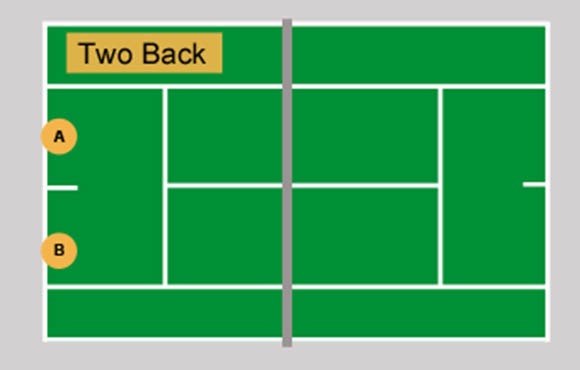
Under ITF Rules of Tennis 2026, Rule 26 case 5 allows the server's and receiver's partners to stand anywhere on their respective sides of the net, including outside the court, subject to hindrance. Rules 16 to 18 still govern the server's position behind the baseline, alternating service halves, and the diagonal service box. Under Rule 19(d), a serve that strikes the server's partner is a service fault, so a first-serve contact leaves a second service available under Rule 20. Before serving in a crouched I setup, the net partner should stay clear of the intended serve path; USTA addresses the partner-contact situation.
When Staying Standard Is the Better Call

Stay standard when the variation causes more trouble on the serve and first return than the return pattern it was meant to fix. That happens when the server misses from the shifted position, both players move toward the same half, or the receivers find a newly open lane.
- Serving suffers: The server gets distracted by the unusual start and loses the reliable service motion.
- Two players chase one ball: Server and net partner cover the same lane while the return goes to the other.
- The receiver adapts: Repeated line returns, lobs, or balls behind the net player exploit the altered coverage.
A USTA 4.0 player struggled to influence a match because opponents kept targeting their partner, and attempts to poach left an opening behind them:
Yesterday we lost a USTA 4.0 doubles match in 6-3, 6-2. I felt I was playing great, held my serves easily and was putting a lot of pressure on my opponents with my returns. I had a weak partner and any chance my opponents got they would hit the ball at my partner. We would end up losing 90% of the points like this. The few times I tried to poach the balls I got passed behind me. I couldn't think of a way to be useful when my partner was serving because they would always return the serve well wide off me, and then start the vicious cycle of relentlessly hitting the ball at my partner. Opponents had a strong serve game as well and my partner had tough time returning. Is there anything I could do to ease the pressure off my partner and be more useful?
The failure was specific: moving toward one return created room behind the net player for another.

If the same breakdown keeps appearing, reset to the familiar one-up, one-back setup and fix the failed movement before trying the variation again.
A Simple Court Test Before Match Play
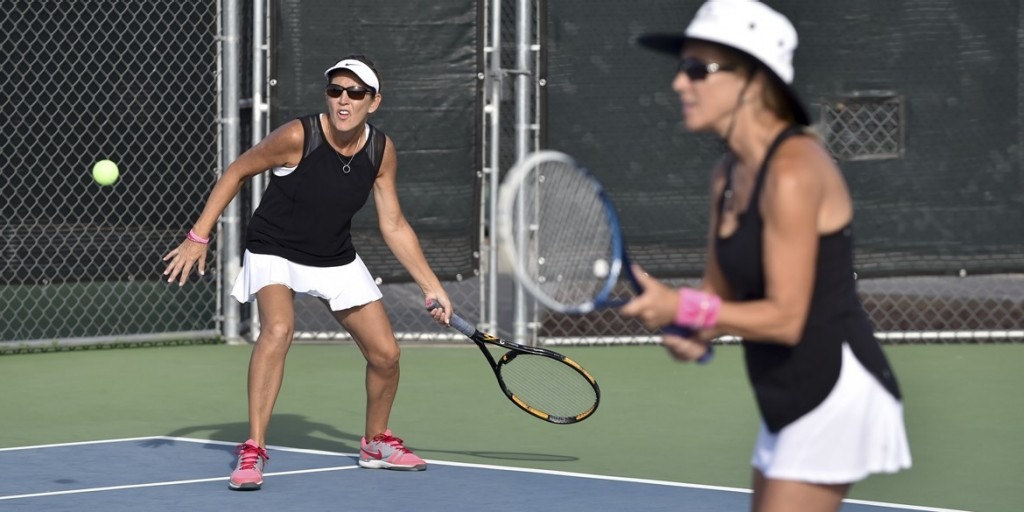
Compare the variation with standard positioning against similar first returns. Start with a dry run: the net partner picks a side, the server names the half that remains, and you both move on an imaginary serve. For Australian, the server names the half to recover into and the net partner names the lane being challenged. Then add a returner who plays a comparable return toward the troublesome channel, and keep the service side and serve target the same across trials.
Copy this blank record for each point in a notebook or on a printed practice sheet. The fields separate a missed serve from a coverage error.
| Observation field | What to enter after the point | Your record |
|---|---|---|
| Formation and service side | Standard, Australian or I; deuce or ad | |
| Serve target and result | Intended box area; legal serve or fault | |
| Net-player movement | The net partner's planned direction and actual first move | |
| Server recovery | The server's intended half and actual first coverage | |
| Return path and breakdown | Where the returner sent the ball; open lane, missed interception or unclear call |
A legal serve followed by both partners reaching the same half points to a movement problem. A fault before the returner hits points to the service setup. A return that keeps finding a defended lane points to a second look at the original formation choice.