
Start with mini-tennis or a partner feed. Move back only when you can both keep a rally going. If it falls apart, step closer or make the feed easier, then write down one result for next time.
You have two rackets, a few balls, a court, and a friend who is learning just as you are. The first ball crosses the net. The next one goes into the fence. Then someone spends another minute collecting balls.
Pick a drill you can both finish, give each person a job, and make it harder only as your control improves.
These drills need two players and ordinary court equipment. In a cooperative drill, you help your partner hit the ball back. Add scored points later, once you want a different challenge.
Pick your starting drill
Choose your first drill by what you can both control today. A pair that can return a gentle toss starts in a different place from a pair that can trade several shots over the net.
Try a few easy attempts near the service boxes, the smaller areas between the net and the service line, to see which row fits you.
| What you can do now | Start here | Easier option | Try next when ready |
|---|---|---|---|
| Neither player makes reliable racket contact | Toss, bounce, and catch | Shorter, gentler toss | One racket hit |
| One player can return a predictable ball | Partner-fed single shots | Underhand toss into a broad area | Separate forehand/backhand sets |
| Both can exchange gentle balls at short range | Service-box mini-tennis | Restart each attempt with a toss | Longer rally |
| Both can maintain a short rally | Directional short-court rally | Aim toward a large central area | Move farther back |
| Both exchange balls reliably from a longer distance | Serve and return | Start with an easy feed | Add a second shot |
A good first drill gives each of you a realistic chance to hit the next ball. If you can't do that yet, begin with a toss or a bounce.
Agree on pace, targets, and roles before the first ball
Before you start, agree on what a good ball looks like: one your partner can reach comfortably, with time to prepare the next shot.
Call the players A and B. In a feeding drill, A feeds the ball and B hits it back to the target. In a rally drill, you both try to keep the ball going.
Agree on four things:
- Pace: Send a ball your partner can prepare for. Don't try to hit a winner.
- Target: Aim into a broad, reachable area of the court. The rest of this guide calls it the target.
- Roles: Decide who starts the ball. A set is 10 balls, then you swap feeder and hitter.
- Stop signal: Stop play before collecting scattered balls, and keep retrieval clear of active courts and swinging rackets.
Rallies and scored points call for different choices. In a rally drill, a ball your partner can't reach stops practice for both of you. In a scored point, hitting out of reach is the whole idea.
This helps most when you each expect something different. One of you wants a gentle warm-up, the other starts driving balls deep. Settle the purpose first.
When neither of you can rally: toss, bounce, and hand-feed drills
You can work on ball control before you can hit back and forth over the net. A predictable feed lets the receiver watch the ball and focus on contact, while the feeder learns to deliver an easy one.
Drill 1: Toss, bounce, and catch
Stand a comfortable tossing distance apart near a service box, with open space for the ball to bounce in front of the receiver. Put the rackets down for the catching version.
A tosses the ball so it lands in front of B. B watches the bounce, catches it, and tosses it back for the next attempt.
A good toss bounces within easy reach and gives B time to catch it. If B has to run across the court, aim for an easier landing spot.
Once you both track and catch the bounce reliably, B picks up the racket and sends the same ball toward an open, safe area. That adds one racket hit and keeps the feed familiar.
Drill 2: One controlled return
A stands on one side of the net near the service line. B waits inside the opposite service box, with room between their body and the net. A tosses the ball gently over the net so it bounces a little in front of B. B lets it bounce once, then hits it toward the middle of A's service box.
A catches the return if it's within easy reach, or picks it up once it stops, then tosses the next ball.
Count the returns that clear the net and land in the target on A's side.
For a harder version, A feeds with the racket, gently, to the same landing area. Keep the distance and the bounce spot within what you both can control, with safe spacing.
Build your first mini-tennis rally in the service boxes
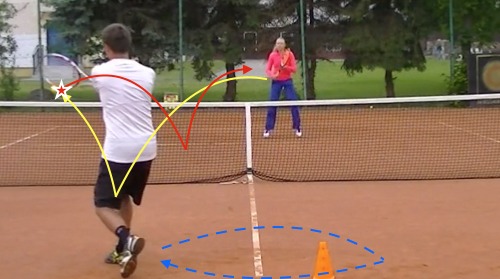
Mini-tennis is a short-court rally where you both try to keep the ball in play. It gives you a smaller area to handle before you take on the timing and movement of a full-court rally.
Drill 3: Cooperative service-box rally
Stand on opposite sides of the net in or near your service boxes. A starts with a gentle ball. B hits it back toward A's half of the service box, and A sends another easy ball back.
Each return gives the receiver time to set the racket and hit the next ball.
Aim for three hits in a row, counting the first.
When you can both repeat the rally, make one thing a little harder.
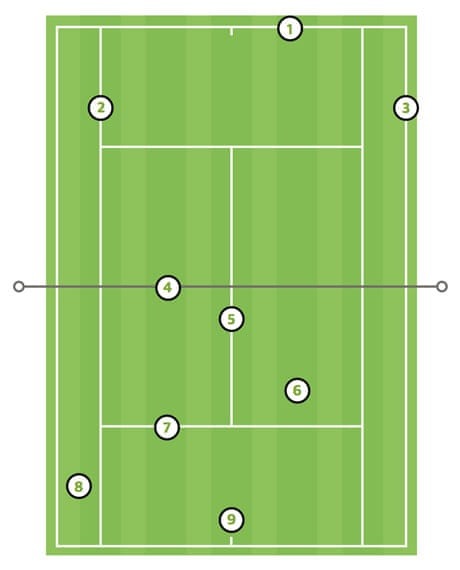
Do you need slower tennis balls?
A standard tennis ball works for this drill. Slower, lower-compression balls are another way to adjust the conditions if you have them.
The ITF Tennis Play and Stay program describes modified balls and playing areas as ways to introduce tennis.
The USTA Red Ball Tennis FAQs, updated April 14, 2026, describe Red Ball Tennis as a format for beginners and returning players.
A 2025 scoping review by Piquer-Piquer and colleagues examined 35 empirical studies of equipment modification for novice tennis players. Much of that evidence involved younger learners, so it can't tell you how fast recreational adults improve.
Trade feeder and hitter roles for forehand and backhand practice
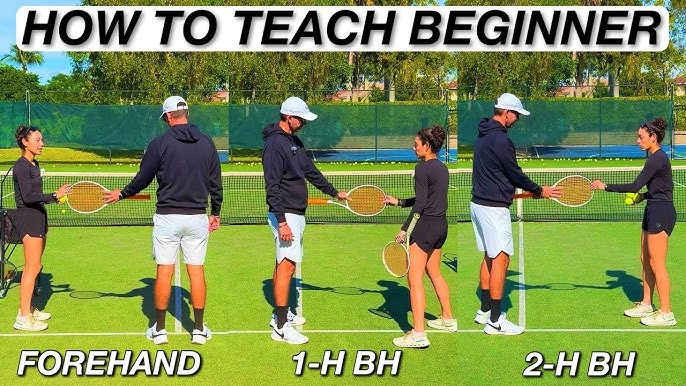
Once a predictable feed gets you an easy return, give the hitter one stroke goal at a time. A consistent feed to a known side makes it easier to see whether you're controlling the ball.
Drill 4: Known-side forehand and backhand feeds
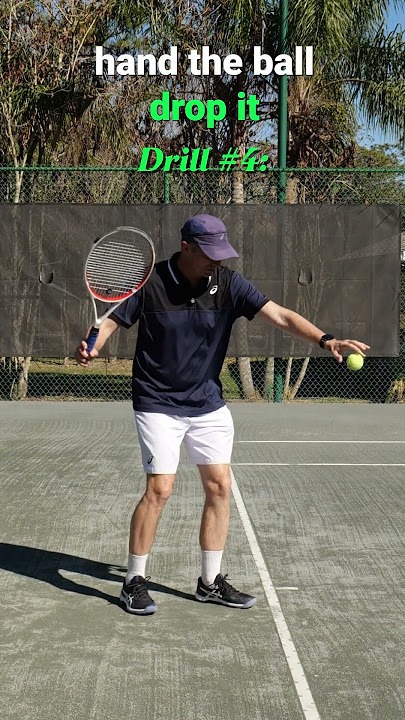
Use the Drill 2 setup. A tosses an easy underhand ball that bounces in front of B's forehand side. B hits it back toward the middle of A's service box, and A picks up the ball before the next feed.
Start with tosses until A can land the ball in the same spot every time. A gentle racket feed then gives the feeder a separate challenge.
Do a set of forehand feeds first, then a set of backhand feeds to a similarly big target. Then swap A and B so each of you hits both sets.
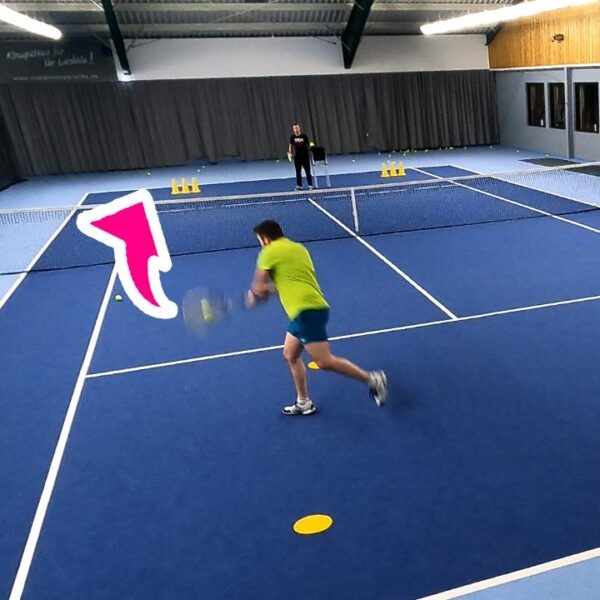
For each set, count the balls that reach the target. Compare forehand and backhand results using the same type of feed and the same target.
If one side keeps producing fewer good returns, give it extra repetitions with predictable feeds at your next practice.
To make it harder, A picks forehand or backhand without telling B, so B has to read which side the ball is heading for.
Move back gradually and add a simple direction target
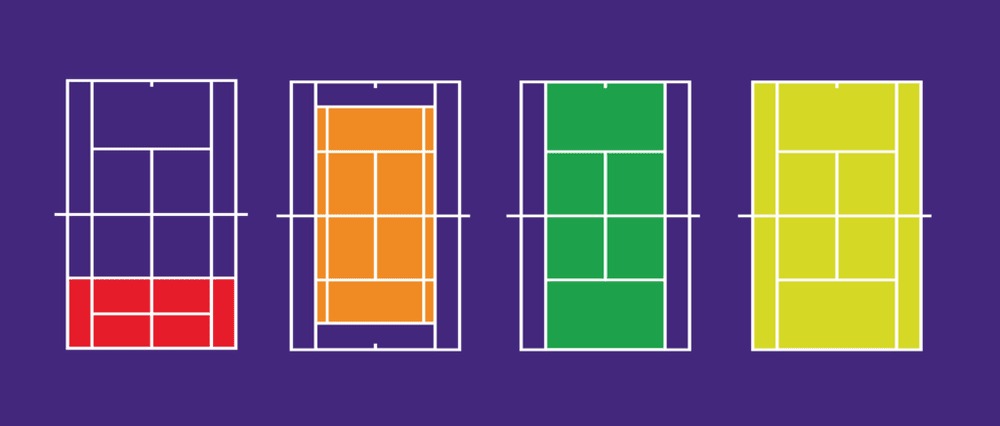
Once you can sustain a short rally, add one new difficulty: more direction control at the same distance, or more distance with the same big target.
Drill 5: Aim toward a broad direction
Begin from a service-box rally that you can both complete.
Choose an area toward the middle of the court or a comfortable crosscourt direction. A starts with an easy ball, and you both aim your returns that way.
A good ball is one your partner can handle without being pulled out of the rally. Precise line hitting can wait.
Once that direction works for several attempts in a row, pick a new one and keep the distance the same.
Drill 6: Increase the distance
Keep the rally goal and target from Drill 5. Move back a little together, then repeat the same drill.
Compare the two sets using the same ball, starting feed, and target. Stay at the longer distance once you can both keep rallies going there repeatedly.
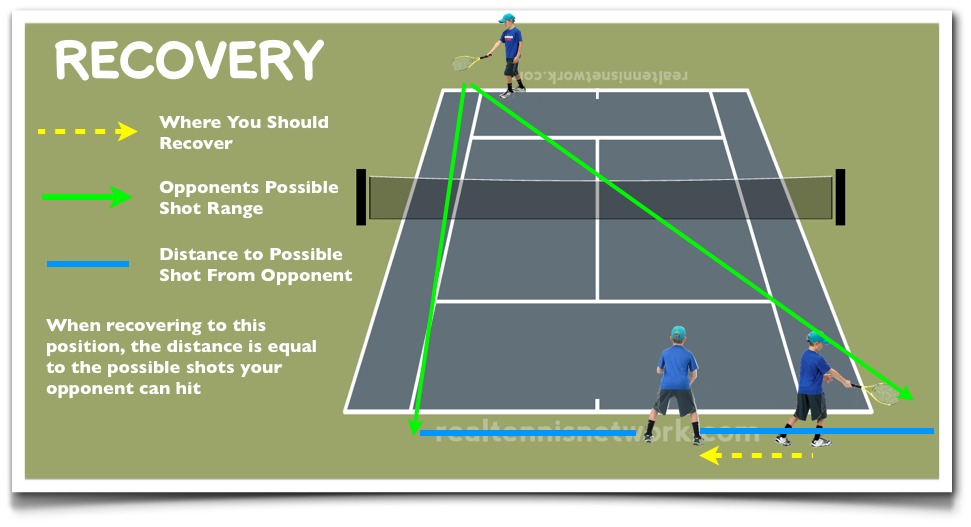
The bigger court also means recovering between hits. For baseline rallies, USTA's Ready, Rally and Recover drill teaches players to return to a central home-base position after each shot. On the short court, recover to a spot that suits the smaller area and your partner's next ball.
Adjust the drill when one partner is stronger or hits too hard
If you're the stronger player, start each exchange with a gentle feed to the middle of your partner's side.
The receiver can say what bounce height and pace feel comfortable, and you can adjust the court spacing to match. Swap roles so both of you practice feeding and receiving.
Fix the drill that keeps breaking down
When a drill keeps failing, pick one visible problem and change one thing. A small change is easier to judge than changing the distance, ball, target, and feed all at once.
| What keeps happening | First change to try | What to watch on the next set |
|---|---|---|
| The first racket contact rarely works | Go back to an easy underhand toss or bounce feed | More clean first hits |
| Balls keep traveling too deep or too fast | Use a shorter setup and a broad, reachable target | More balls arrive where the receiver can prepare |
| Many short-court returns go into the net | Keep the feed the same; ask the returner to aim higher over the net toward the same target | The next player gets more balls they can hit |
| One partner takes nearly every shot | Define the feeder and receiver roles, then switch | Both of you get to receive and feed |
If you both get more balls you can hit, keep the change. If the rally gets worse, go back to the earlier setup.
A repeated miss can have several technical causes. If an easy drill stays out of reach even with simpler feeds and shorter distances, a qualified coach can spot the stroke problem.
Turn the drills into a short session you can measure
Here's a 40-minute session with five optional minutes at the end. Stretch or shorten the blocks to match your level. If you're still learning the first feed, spend longer on that block and shorten the later ones.
| Time | Activity | Main purpose |
|---|---|---|
| 0 to 5 minutes | Easy starter feeds and identify your current level | Find a workable first task |
| 5 to 15 minutes | Forehand or backhand feeds, swapping roles | Repeat the same hit |
| 15 to 25 minutes | Service-box rallies | Build a rally |
| 25 to 35 minutes | Directional rally or gradual distance change | Try one step up |
| 35 to 40 minutes | Review the chosen drill and note one result | Keep a record you can compare |
| Optional 40 to 45 minutes | Continue an effective drill or try a simple serve-and-return exchange | Practice the skill from a slightly different starting point |
When you're ready for a simple serve and return
Once you can both keep a rally going, A starts the ball with an easy serve and B returns it toward the target. A then tries to keep the rally going for another shot.
A return that stays in play counts as a success.
If the serve is too hard to return, start the ball with an easy feed instead. For a harder version, add one more shot after the return.
Keep a small practice record
At the end of the session, record these details in a notebook or phone note:
- Date and equipment: Note the date and whether you used standard or modified balls.
- Court setup: The service-box area or longer court distance you used.
- Drill and roles: Which drill, and who fed or received first.
- Result: The number of playable contacts, or your best repeatable rally.
- Next change: One adjustment to try next session.
For example, a log might read: “Standard ball; service boxes; cooperative rally; A starts; longest streak: 2.” In a second attempt with the same ball, court area, and starting feed, you record a streak of 4.