
If your event replaces the deciding set with a 10-point match tiebreak, the first player or team to reach at least 10 points with a two-point lead wins. The next player due to serve starts from the deuce court, and service then alternates every two points. Change ends after every six completed points or under the Coman procedure, whichever your competition specifies. Confirm the event format before point 1.
When does a 10-point match tiebreak replace the deciding set?

Say you win the first set 6-4, lose the second 3-6, and the tournament director announces a match tiebreak instead of a third set. You skip the third-set games and count individual points toward ten.
A replacement match tiebreak decides the match instead of the scheduled final set. A ten-point tiebreak can also start after a deciding set reaches 6-6, when the competition uses that format.
| Format | When it starts | Points needed | What it decides |
|---|---|---|---|
| 10-point match tiebreak | After the first two sets are split, if the event replaces the deciding set | At least 10, win by 2 | The match in place of the deciding set |
| 10-point final-set tiebreak | At 6-6 in a deciding set, when required by the competition | At least 10, win by 2 | The deciding set already in progress |
| Standard 7-point tiebreak | Usually at 6-6 in a regular tiebreak set | At least 7, win by 2 | That set |
The ITF Rules of Tennis 2026 define the two ten-point formats separately. Which one applies depends on the competition's published rules, and a "super tiebreak" announcement doesn't say. For ordinary set tiebreaks, see how a standard seven-point tiebreak works.
Under ITF Appendix VI, the break before a replacement match tiebreak is 120 seconds. Balls are not changed at its start, even if a change would otherwise be due.
What happens at 9-9 or after 10 points?

At 10-9, play continues because the lead is only one point. You need at least ten points and a two-point margin, so 11-9 is final.
| Score | Finished? | Reason |
|---|---|---|
| 9-9 | No | Neither side has ten points |
| 10-8 | Yes | Ten points and a two-point lead |
| 10-9 | No | One-point lead |
| 11-9 | Yes | Two-point lead |
| 11-10 | No | One-point lead |
| 12-10 | Yes | Two-point lead |
| 13-11 | Yes | Two-point lead |
After 9-9, the score can go 10-9, 10-10 and 11-10 before 12-10 ends it. There's no maximum score.
A doubles player on r/10s described a comeback during a match tiebreak:
In the tiebreaker, we just couldn't get a point at first. At 0-7 we finally got a point. Then our opponents got 2 points in a row so the score was 1-9. Then something crazy happened - we got 9 points in a row! I had to serve when the score was 8-9 and that was the most nerve wracking moment of the game for me. We ended up winning 13-11.
Who serves first in a 10-point match tiebreak?
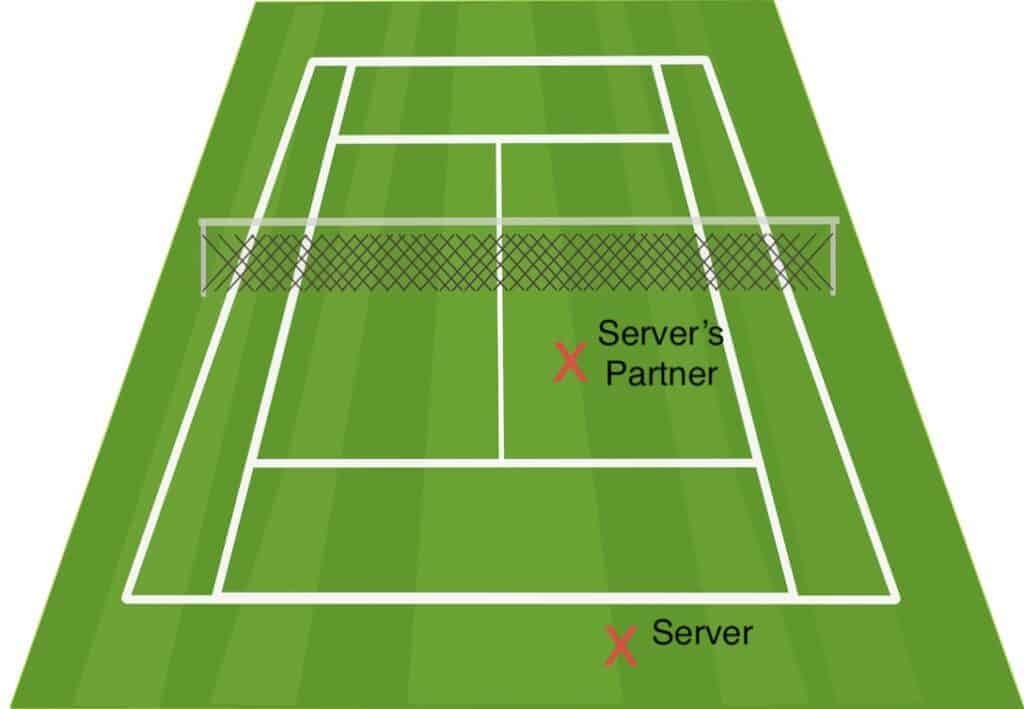
Whoever is next in the serving order serves point 1 from the deuce (right) court. The opponent serves points 2 and 3, and after that each player serves two points in turn.
If A is next, A serves point 1, B serves points 2 and 3, and A serves again for points 4 and 5. The service box alternates with each point: odd-numbered points start on the deuce/right side, even-numbered points on the ad/left side.
How do serving and receiving orders work in doubles?
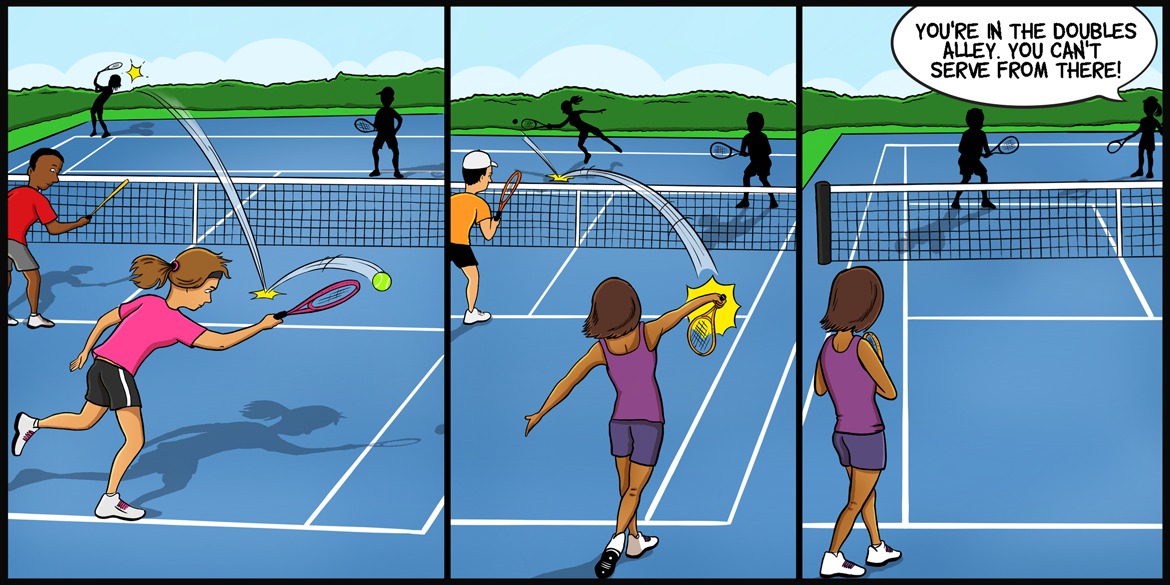
The team due to serve next keeps that turn when a replacement match tiebreak begins. Because the tiebreak replaces a set, partners choose their serving and receiving orders as they would at the start of a new set. If Team A is due first, it picks which partner serves point 1, and Team B takes the next two-point service turn. Those choices then set the rotation for the rest of the tiebreak; see doubles serving and receiving rotation for the broader rules.
Which changeover rule applies: regular or Coman?
The conventional tiebreak changes court ends after every six completed points: 6, 12, 18 and so on. The Coman procedure switches ends after point 1 and then after points 5, 9, 13 and so on. The serving rotation continues through either one.
The USTA Southern California Coman instructions explain the regional procedure, while ALTA's 10 Point Tiebreak Instructions specify changes after every six points. Your event's adopted rule decides which schedule applies, including any permission to agree on an alternative.
A doubles player described a dispute after a tournament director announced Coman but said the players could agree on a different procedure:
It was honestly so silly. We go to a third set tiebreak in the semis of open doubles and the guy asks the tiebreak format and the tournament director says it’s Coman but we could do the other way if we all agree. I said I’d prefer Coman and he says, “guess we are doing Coman. Didn’t realize we were playing woke tennis”.
How do you keep score and track the tiebreak point by point?

Track four things: the score, who serves next, which box they serve from, and whether an end change is due. The table follows the first 13 points, with A serving first.
| Point | Server | Service court | Completed points | Conventional change | Coman change |
|---|---|---|---|---|---|
| 1 | A | Deuce/right | 1 | No | Yes |
| 2 | B | Ad/left | 2 | No | No |
| 3 | B | Deuce/right | 3 | No | No |
| 4 | A | Ad/left | 4 | No | No |
| 5 | A | Deuce/right | 5 | No | Yes |
| 6 | B | Ad/left | 6 | Yes | No |
| 7 | B | Deuce/right | 7 | No | No |
| 8 | A | Ad/left | 8 | No | No |
| 9 | A | Deuce/right | 9 | No | Yes |
| 10 | B | Ad/left | 10 | No | No |
| 11 | B | Deuce/right | 11 | No | No |
| 12 | A | Ad/left | 12 | Yes | No |
| 13 | A | Deuce/right | 13 | No | Yes |
At 4-2, six points have been completed, so players change ends under the conventional procedure. Under Coman they already switched after the fifth point, and B serves the seventh point from the deuce court.
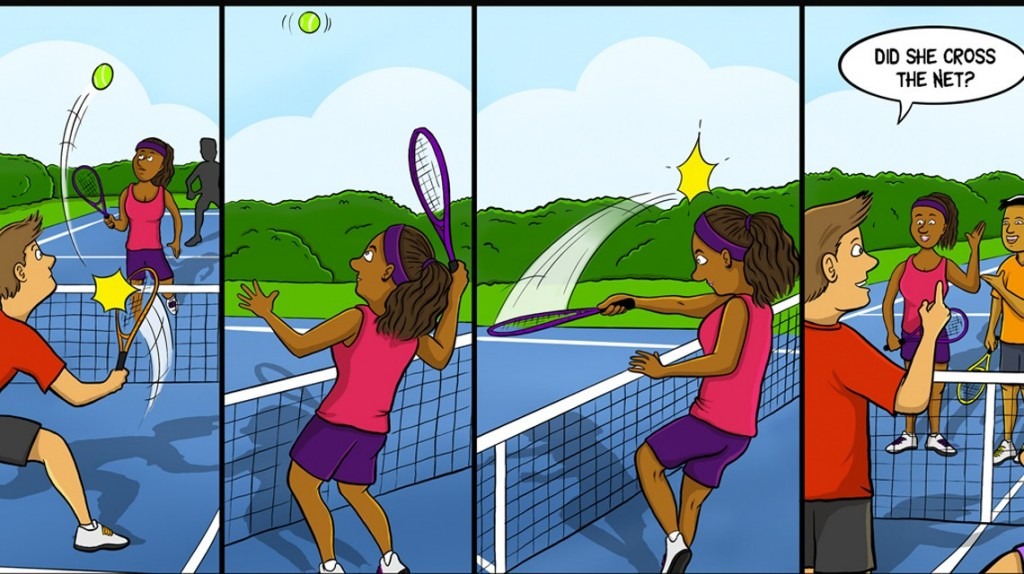
Add one to the winning side's score after each rally. The two scores add up to the completed points, the next point number gives the service box, and the serving rotation gives the server. End-change entries in the table apply only if another point remains to be played.
How do you report a 10-point match tiebreak result?
Write the two sets first, then the match tiebreak as the deciding result. If A wins 6-4, loses 3-6 and wins the match tiebreak 10-8, the result reads 6-4, 3-6, [10-8].
Under the USTA Friend at Court scoring convention, a replacement match tiebreak is recorded as 1-0(x), where x is the losing side's tiebreak-point total, or by a bracketed tiebreak score. For the 10-8 example, the deciding-set entry is 1-0(8), and [10-8] is the tiebreak-point score.
Enter the two sets and the tiebreak in the fields your organizer's score-reporting form provides.
What if players disagree about the format or follow the wrong procedure?
Rule 27 of the ITF Rules of Tennis sets different corrections for a wrong server, wrong receiving order, wrong court end and an incorrectly started deciding set. The type of error and when you discover it both matter.
Say the event specified a replacement match tiebreak, but the players began a conventional deciding set. Rule 27(h) gives three outcomes:
- Only one point played: Correct immediately to the agreed match tiebreak, keeping the point already played in the score.
- Second point already in play: Continue the set until a player or team wins three games, or the games reach 2-2; at 2-2 play the agreed match tiebreak, provided the later fifth-game threshold has not been reached.
- After the second point of game five has started: Continue the set as a tiebreak set under the error-correction rule.
Points already played stand. A wrong-end change or a service-order error follows its own Rule 27 provision.
If players dispute the procedure during play, give the referee or tournament director the score, the actual service sequence, the intended match format and the moment the error was discovered. Those details determine which correction applies.