
In doubles, teams alternate service games, and partners take turns serving within each set. Each team's deuce-side and ad-side receivers stay fixed for the whole set, including a tiebreak at 6-6. A new set, or a match tiebreak that replaces the deciding set, lets partners choose their order again, while the team that serves next stays fixed. Confirm the format and write down the four players' assignments before you play.
Doubles scoring in one minute: what stays the same, and what changes?
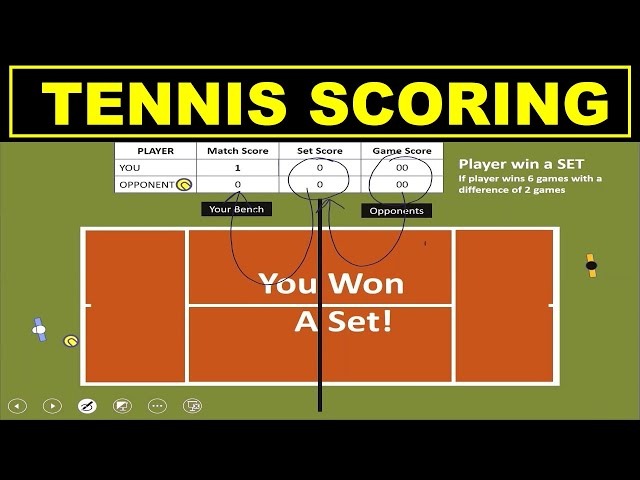
A doubles game uses the usual points: love, 15, 30 and 40, with the serving team's score called first. Under advantage scoring, 40-40 is deuce, and a team must win two consecutive points from deuce to win the game. What changes in doubles is the bookkeeping, because you now track serving and receiving duties for four players. A league, club or tournament may announce an approved alternative such as no-ad scoring, and the announced format governs.
Who serves each game in doubles? The four-player rotation
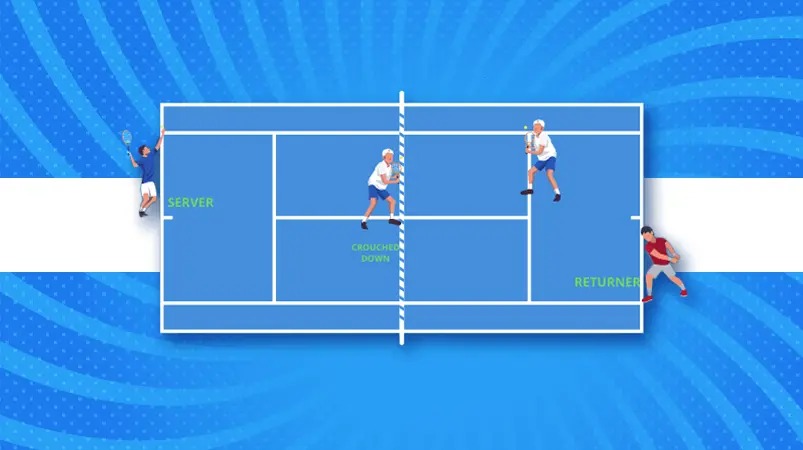
One player serves an entire standard game, including any second serves. Teams alternate service games, and the partners on each team take turns serving within the set.
Call the players A1 and A2 on Team A, and B1 and B2 on Team B. Say A1 serves the first game and Team B picks B1 for its first service game. The sequence runs A1, B1, A2, B2, then repeats.
| Game | Serving team | Server | Next-game server |
|---|---|---|---|
| 1 | A | A1 | B1 |
| 2 | B | B1 | A2 |
| 3 | A | A2 | B2 |
| 4 | B | B2 | A1 |
| 5 | A | A1 | B1 |
| 6 | B | B1 | A2 |
| 7 | A | A2 | B2 |
| 8 | B | B2 | A1 |
A1 serves again in game 5 because both Team A partners have served once. B1 follows in game 6, and the cycle continues.

The assigned server stays at the baseline for the whole game. Which receiver returns depends on the service half.
Without a serving-order error, game 9 returns to A1.
Who must receive the serve, and can doubles partners change receiving sides?

Each team picks one partner to receive on the right (deuce) side and the other to receive on the left (ad) side. That arrangement stays fixed through the set, including a tiebreak within it.
Say Team A assigns A1 to the deuce side and A2 to the ad side. When Team B serves game 2, A1 returns serves to the deuce court and A2 returns serves to the ad court. Game 4 works the same way.
Changing ends doesn't change those assignments. After a changeover, the receivers stand at the opposite baseline but keep the same deuce and ad roles.
While playing doubles, me and my entire group of friends used to think that receiver positions keep changing between games. Recently I found out that the positions are fixed for the entire set. Does this rule apply to the tiebreak too? I’m not able to confirm this clearly, by googling. Can someone please point me to some sort of official rule page that clarifies this?
ITF Rule 15 keeps the chosen receiving order through the set, so reaching 6-6 doesn't start a new one.
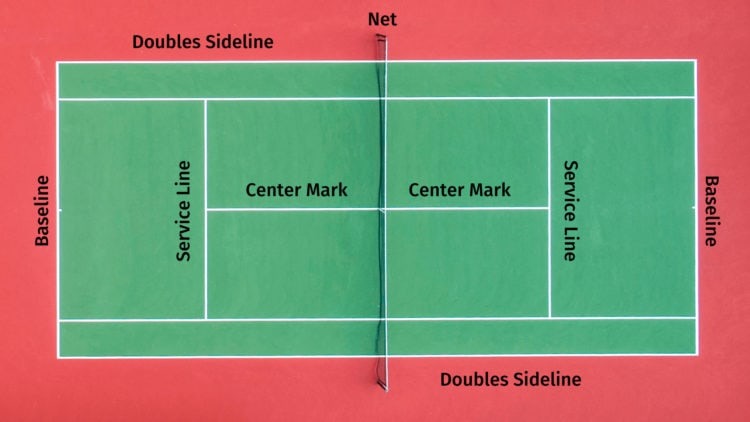
The assigned receiver must return the serve. The other partner can stand near the net in a legal position, but being close to a short serve doesn't make that player the receiver. After the legal return, either partner can play the next shot.
One exception applies when a sanctioning body permits Short Sets, No-Ad scoring and the No-Let rule together in doubles. In that case, either receiving partner may return a serve that touches the net, strap or band and then lands in the correct service court.
How the doubles tiebreak serving order works at 6-6
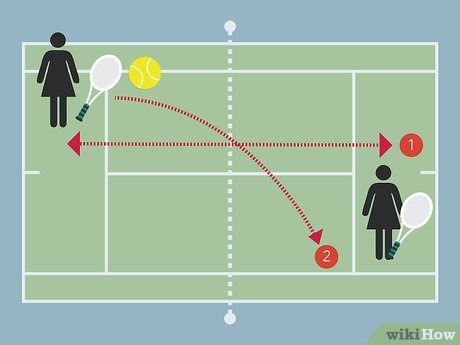
When a set reaches 6-6 under the regular tiebreak format, the player due to serve the next game serves the first tiebreak point. The next player in the sequence serves points 2 and 3, and each following player serves two points.
The first team to reach seven points with a two-point lead wins the tiebreak. Points are counted numerically, so the score might go from 1-0 to 2-0 to 2-1.
In the example, B2 serves game 12, so A1 is due next and serves tiebreak point 1.
| Tiebreak point | Individual server | Team | Service half |
|---|---|---|---|
| 1 | A1 | A | Right/deuce |
| 2 | B1 | B | Left/ad |
| 3 | B1 | B | Right/deuce |
| 4 | A2 | A | Left/ad |
| 5 | A2 | A | Right/deuce |
| 6 | B2 | B | Left/ad |
| 7 | B2 | B | Right/deuce |
| 8 | A1 | A | Left/ad |
| 9 | A1 | A | Right/deuce |
The tiebreak ends as soon as a team reaches the winning target and margin, so the table shows the order only if play goes that far.

One recreational player drew a full doubles-set diagram and still got stuck at the tiebreak transition:
Where I am getting confused is when the tiebreak begins. In this example, Player A1 is next in the service rotation (from the near court) and they serve one point. But in the next point, there is no switching sides but the service passes to Team B. Player B1 is next in the rotation but that player is now serving from the far court which is a different side of the court than they served during the set.
The confusion comes from treating two separate things as one. The end you stand at and whose turn it is to serve have nothing to do with each other. B1 can serve in the tiebreak from a different end than in earlier games, because the sequence follows individual serving turns.
Who serves point 10, and from which half? B1, from the left/ad half. B1 takes the next two-point block after A1's points 8 and 9.
First tiebreak serve: deuce side, ad side, or a change of ends?
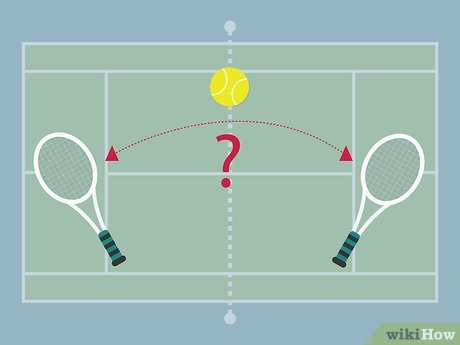
The first tiebreak point is served from the right (deuce) half. Service then alternates right, left, right, left with each point, whoever has the serve.
The service half is defined relative to the server and the center mark. The physical end is the baseline you serve from. Switching baselines changes the end, and the right/left sequence continues.
In a standard tiebreak, players change ends after every six points, starting after point 6 and again after point 12 if play reaches that point. Under the approved Coman procedure, they change ends after point 1 and then every four additional points: 1, 5, 9, 13 and so on.
Neither procedure changes who serves a point or swaps the receiving partners' deuce and ad roles. Under both, a seventh tiebreak point is served from the right/deuce half.
One player described being talked into starting a deciding tiebreak from the ad side, then losing track of the sequence:
I start serving on the deuce side and my opponents stops the play saying in a tiebreak I'm supposed to start playing on the ad side? I was puzzled, but since I always tend to avoid controversy and didn't really care which side I should start I said "ok let's start from the ad side", then during all the tiebreak I was messing up the side, and I'm 90% sure my opponent also messed up the sides following his own rule.
The 2026 Long Island Local Rules and Regulations for USTA Eastern league play give one example of a local format that uses Coman end changes with a match tiebreak replacing the third set.
New set or 10-point match tiebreak: when can partner orders change?
At the start of a new set, partners can choose their serving and receiving arrangements again. The same applies to a match tiebreak that replaces a deciding set. A tiebreak at 6-6 within a set keeps that set's assignments.
A new full set
Each team chooses which partner takes its first service game in the new set. The receiving team also chooses who receives on the deuce side and who receives on the ad side.
After a set tiebreak, the team that served the first point receives in the opening game of the next set. If Team A served point 1 of the tiebreak, Team B serves the first game of the next set.
A match tiebreak replacing the deciding set
Some approved formats play a match tiebreak in place of an entire deciding set. One such format goes to ten points, with a two-point winning margin.
At the start of this tiebreak, each team can choose its partner serving and receiving order as it would at the start of a set. The established service succession still decides which team serves next.
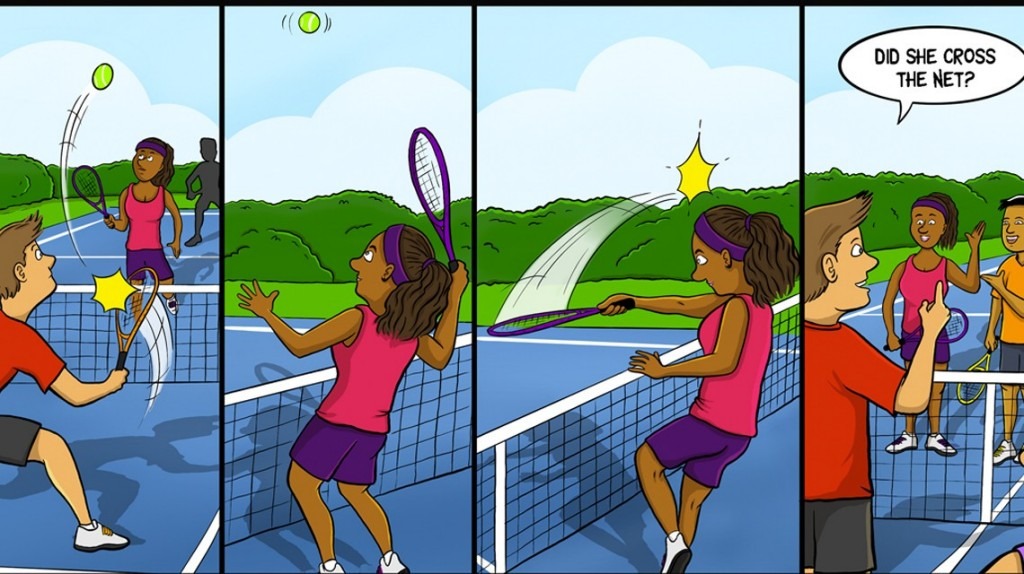
A ten-point tiebreak within a final set
An approved final-set format may call for a ten-point tiebreak when that set reaches 6-6. It happens inside the existing set, so players keep their previous serving and receiving order.
| Situation | Scoring target | Internal serving and receiving order |
|---|---|---|
| New full set | Announced set format | Can be chosen again |
| Set tiebreak at 6-6 | First to 7, win by 2 | Continues existing set order |
| Match tiebreak replacing a deciding set | First to 10, win by 2 in the specified alternative | Can be chosen again; team order stays fixed |
| Ten-point tiebreak at 6-6 in a final set | First to 10, win by 2 | Continues existing set order |
ITF Appendix VI also approves a seven-point match tiebreak that replaces a deciding set, so the point target alone doesn't tell you which format is in use.
No-ad doubles: who receives the deciding point?

With no-ad scoring, the point at 40-40 decides the game. The receiving team chooses whether that point is served from the deuce or ad side.
The chosen side decides which of the existing receivers takes the return. If Team A assigned A1 to receive on the deuce side and A2 on the ad side, choosing deuce means A1 receives and choosing ad means A2 receives. Picking a side never lets partners swap assignments for that point.
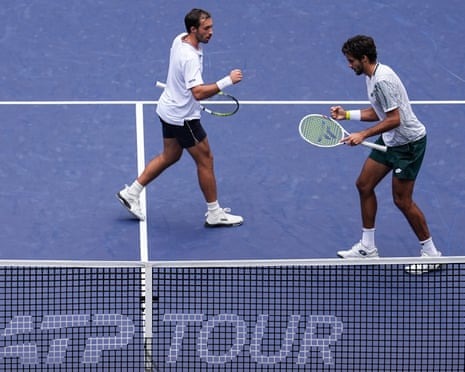
In the mixed-doubles no-ad alternative described by ITF Appendix VI, the receiver is the player of the same gender as the server. The receiving partners can't change positions for that point.
Under advantage scoring, 40-40 leads to advantage after the next point and can return to deuce. The deciding-point choice applies only in no-ad formats.
What happens if the wrong player serves or receives?

ITF Rule 27 sets a separate correction for each error: serving from the wrong service half, standing at the wrong end, serving out of turn and receiving out of order. Completed points stand in every case below. The type of error and when it was discovered decide what happens next.
| Mistake | Correction | Fault treatment |
|---|---|---|
| Wrong service half, Rule 27(a) | Serve from the score-correct half as soon as the error is discovered. | A fault served before discovery stands. |
| Wrong physical end, Rule 27(b) | Return promptly to the correct end. | A fault served before discovery does not stand. |
| Wrong individual server in a standard game, Rule 27(c) | Restore the due server when discovered. If the game has ended, the altered serving order remains. | A fault served by the opponents before discovery does not stand; a fault served out of turn by a partner on the same doubles team stands. |
| Wrong individual server in a tiebreak, Rule 27(d) | After an even number of completed points, correct immediately. After an odd number, retain the altered serving order. | Same opponent-versus-partner fault distinction as in Rule 27(c). |
| Wrong designated receiver, Rule 27(e) | Keep the altered receiving order until the current game ends; restore the original order when that team next receives in the same set. | If another error also occurred, its own rule applies too. |
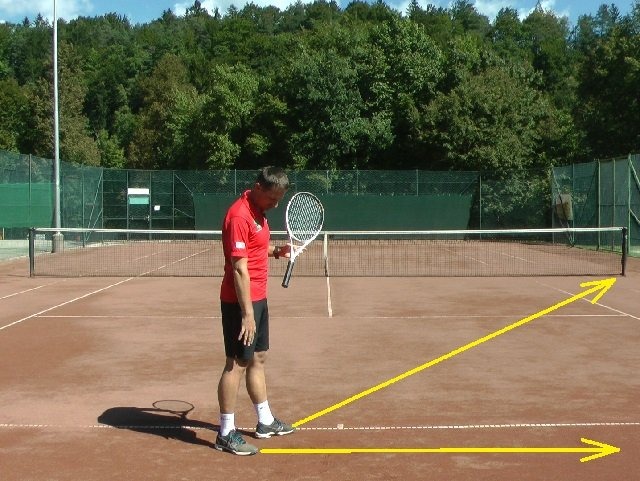
The wrong server in a standard game
Say A1 was due to serve game 5 but A2 began serving. If you catch it during the game, A1 takes over and the completed points remain. If nobody notices until after the game ends, the changed order stays in effect for later games.
The wrong server during a tiebreak
The outcome depends on how many tiebreak points have been played.
- After two completed points: The total is even, so the original serving order is restored immediately.
- After three completed points: The total is odd, so the altered serving order remains.
The wrong receiver
Say A1 was assigned to receive from the deuce court, but A2 returned a serve meant for A1. If the players discover this during the game, the altered receiving order continues until that game ends. When Team A next receives in the same set, its original deuce/ad assignments resume. ITF Rule 27(e) sets this sequence.
If the receiving team stops play after a first-serve fault to discuss the mistake and delays the second serve, USTA Code 30 gives the server a new first serve. The Rule 27(e) correction still applies.
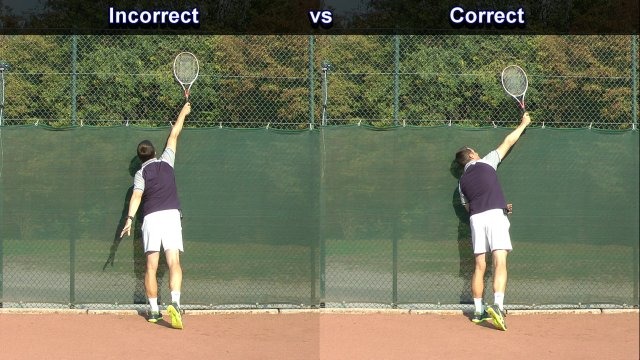
Rule 27(f) through (h) cover errors involving the agreed set-scoring method or an incorrectly started match tiebreak, each with its own procedure.
For a dispute during play, identify the error and when you found it, then apply the matching rule from the ITF Rules of Tennis 2026.
A two-minute pre-match check to keep the order straight
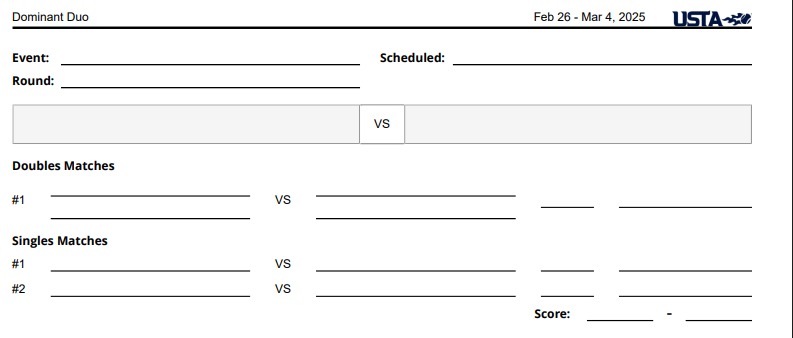
Write down a short lineup before the first serve so all four players share the same record of serving order, receivers and format.
- First serving team: Which pair serves game 1.
- Individual server order: Which partner serves first and second on each team.
- Receiving assignments: The deuce and ad receivers for both pairs.
- Announced match format: Advantage or no-ad scoring, the deciding-set method and the end-change procedure.
Example lineup card
Team A serving order: A1, then A2
Team B serving order: B1, then B2
Team A receivers: A1 deuce; A2 ad
Team B receivers: B1 deuce; B2 ad
First serving team: A
Game scoring: Advantage
Set scoring: Seven-point tiebreak at 6-6
Physical end changes: Standard
The example is a hypothetical configuration on a player-made card, not an official USTA form.