
A 98 and a 100 differ by 2 square inches, about 2%. Frames in the same family also differ in weight, balance and beam, so you are never testing head size alone.
A player who had been on court for just over a month borrowed a 98 after using a 100, and liked how it felt. Another struggled with ball flight during a demo strung far from their usual tension. Both wanted to know how much head size had to do with it.
What does tennis racket head size measure?
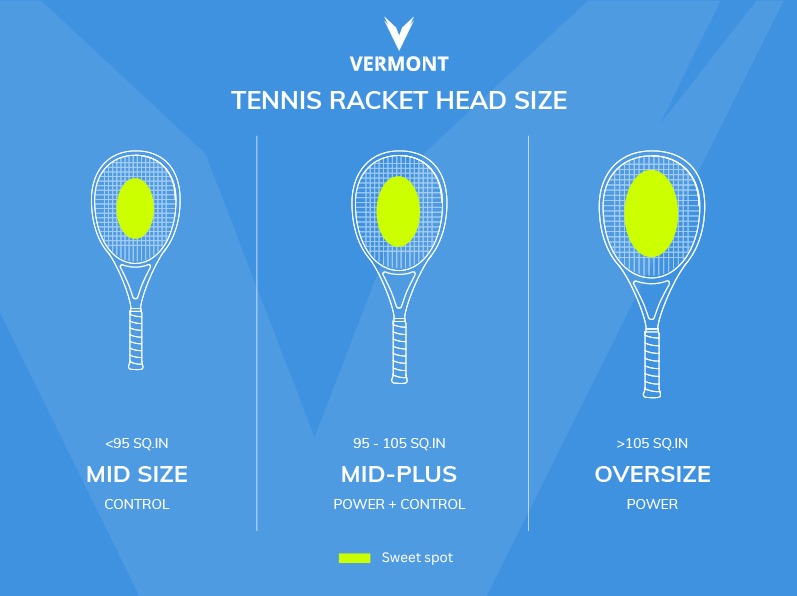
Head size is the nominal area of the racket's hitting face, usually given in square inches on US spec sheets. A racket listed at 100 sq in has a 100-square-inch face. Some sheets show square centimeters instead, and one square inch equals 6.4516 cm².
Racket length, handle circumference and the response of individual contacts are separate characteristics. On a spec sheet, head size sits next to weight, balance, length, beam width and string pattern.
When you compare your racket with a replacement, take the head area from the specification field. The number in the model name is a clue, but the spec field is the reference. You will also see the spelling racquet on specs and in player talk.
Does a larger head automatically mean more forgiveness, power, or control?
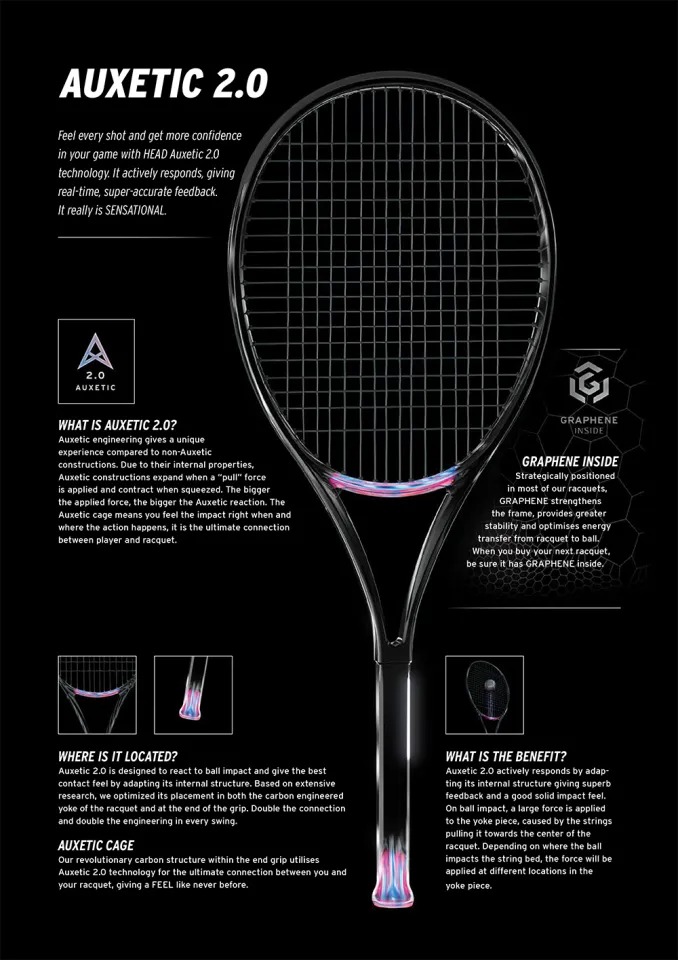
All else equal, a bigger head gives you a larger target, more power and more forgiveness. Smaller heads give a more precise response. Frame construction and string setup decide how strongly you feel either effect.
Sweet spot has several physical meanings. A vibration node is the point where the racket feels best as it vibrates. The center of percussion is a different impact response. Maximum rebound is a third property. A comfortable hit and the fastest rebound can come from different points.
In his 1998 study, Rod Cross examined different sweet-spot interpretations, including vibration-related behavior and the center of percussion.
A later Sports Engineering study by Ripberger and colleagues examined ten rackets and evaluated responses at 23 string-bed locations. It measured impact and feel, including vibration and damping behavior.
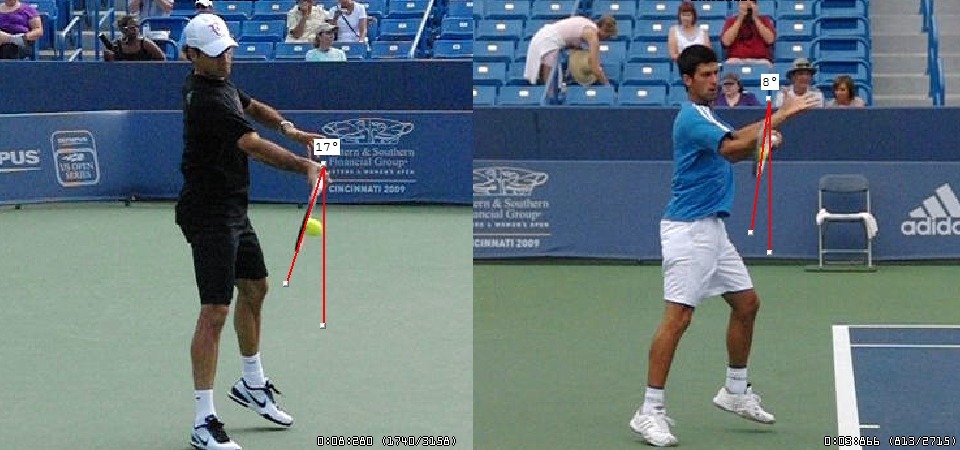
Players use forgiveness to mean a playable result when you miss the ideal spot. Power is the pace or depth you get from a given swing. Control can mean accuracy of direction, predictable depth, or fewer balls flying past the baseline. A racket that feels predictable in gentle rallies can behave differently when a return comes in fast and you make contact late.
Tennis racket head-size chart: from compact to oversized
| Head size | Approximate area | Difference from 100 sq in |
|---|---|---|
| 95 sq in | 612.9 cm² | 5 sq in smaller |
| 98 sq in | 632.3 cm² | 2 sq in smaller |
| 100 sq in | 645.2 cm² | Reference size |
| 105 sq in | 677.4 cm² | 5 sq in larger |
| 110 sq in | 709.7 cm² | 10 sq in larger |
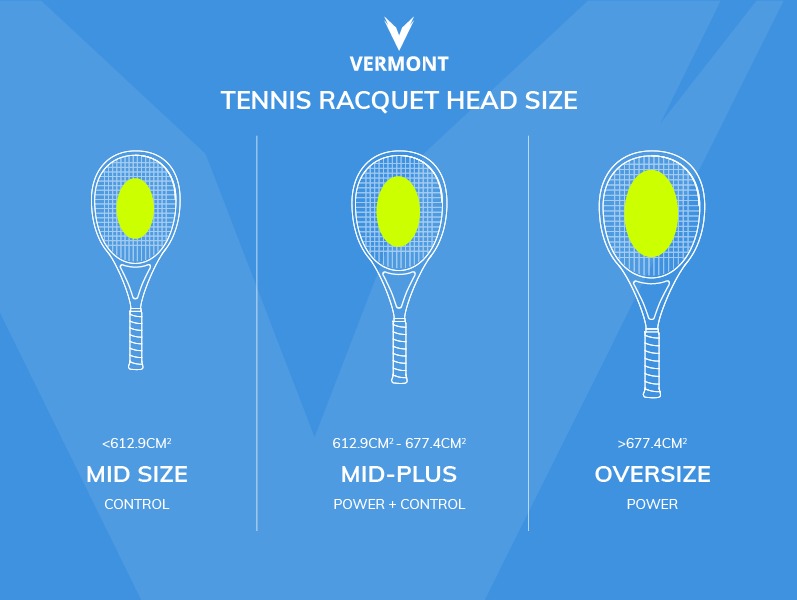
Labels such as midsize, midplus and oversize are looser, and each publisher draws its own lines. Tennis Warehouse's racket-selection guide, for example, uses 85 to 96 sq in for midsize, 96 to 106 for midplus, 107 to 115 for oversize, and 116 or more for super-oversize. Other references use different cutoffs.
98 vs. 100 square inches: how big is the difference?
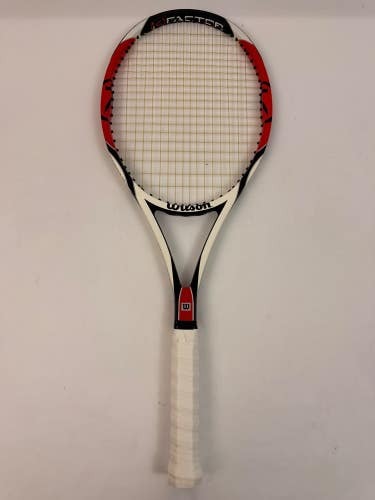
The nominal difference between 98 and 100 square inches is exactly two square inches. Measured against the smaller frame, the change is:
(100 − 98) ÷ 98 × 100 ≈ 2.04%.
In metric terms, the areas are about 632.3 cm² and 645.2 cm², a gap of about 12.9 cm². That 2.04% describes face area only. It says nothing about shot speed, sweet-zone area, accuracy or match results.
Why the head-size number cannot explain every racket difference
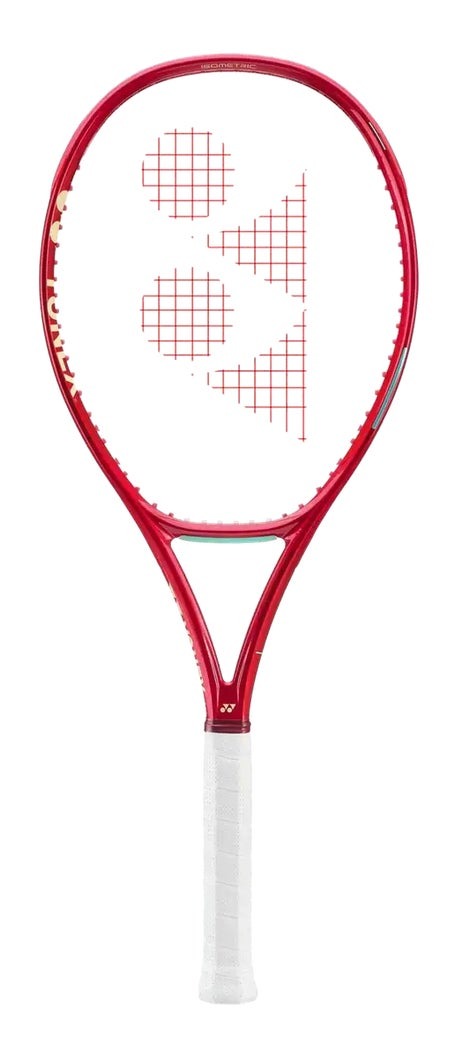
Two models from the same family show the point. Yonex lists the EZONE 98 and EZONE 100 with different unstrung weights, balances and beam dimensions.
| Manufacturer specification | Yonex EZONE 98 | Yonex EZONE 100 |
|---|---|---|
| Head size | 98 sq in | 100 sq in |
| Unstrung weight | 305 g | 300 g |
| Unstrung balance | 315 mm | 320 mm |
| Listed beam dimensions | 23.8 / 24.5 / 19.5 mm | 24.5 / 26.5 / 23.0 mm |
| Length | 27 in | 27 in |
| String pattern | 16×19 | 16×19 |
| Recommended string tension | 45 to 60 lb | 45 to 60 lb |
The two models differ in mass distribution and frame geometry as well as head area. Those differences change handling and impact response.
A demo strung at a very different tension made one comparison hard to read:
I first tried the Ezone 100L which I really liked, so I looked into the heavier versions. Unfortunately, the Ezone 100 demo racket is strung at tension 38, which makes it hard to compare it to my normal 50-55 range. I generally liked the feel of it, but the ball kept shooting out of the court — I’m not sure if it’s due to the tension or the racket itself. My coach let me try his 98 which I thought was a bit heavy and stiffer than the other rackets, but the ball trajectory was normal unlike the 100.
Before you hit, write down the unstrung weight, balance, beam dimensions, string type, tension and string condition for each racket. Yonex gives 45 to 60 lb as its stringing advice for both frames, which is separate from the tension a shop demo carries.
Which head size should beginners and improving players try?
If timing and clean contact are still developing, a generous hitting face is a sensible place to start. A forgotten racket gave one new player a chance to hit with a smaller head:
Just started playing a little over a month ago, and have been playing with a 2025 Ezone 100. Yesterday, I forgot my racquet at home and had to borrow someone’s Ezone 98 and loved how it felt, I really liked the control and response I got from the racquet. Obviously I’m gonna stick with my Ezone 100 (just bought it and I’m a beginner), but it just got me thinking what the biggest differences are between a 98 and a 100 sq inch frame? Aside from the size lmao
| Your situation | What to try | Keep in mind |
|---|---|---|
| Your 100 feels predictable and comfortable | Keep it | Improving as a player does not force a switch |
| You often hit off-center | Try a larger face, such as 102 to 105 | Handling and the whole frame still count |
| A borrowed 98 felt unusually comfortable or predictable | Put a 98 on your shortlist | Confirm it with a comparable trial |
| Someone tells a stronger player to downsize | Keep 98 and 100 in play | Ask for a specific playing reason |
| You want even more face area | Look at larger heads, including 107+ | Check maneuverability and the full frame |
Before you change sizes, name the shot that keeps failing. “I keep catching defensive returns near the frame” is testable. A vague sense that it is time to advance tells you nothing about what to change.
How to demo two head sizes fairly
A fair demo gives each racket the same kinds of shots under similar conditions: court surface, ball condition, hitting partner or feed pattern, and weather.
Hours with a Blade 100 told this player more than a brief hit with a different 98:
The blade I´ve tried was the v10 with 100 head size - it´s my sisters, so I can play it a lot of times when she´s not using it, but I would still need to get my own because sometimes our lessons are at the same time. With that said, should I go for the 100 16x19 or 98 16x19? The 98 should give even more control, and my coach says that its better than the 100. But what dou you think about considering my level? I´ve also tried a 2026 VCore 98, had no problems with sweet spot and really liked how that felt, but I have only used it for like 5 minutes, while the blade I´ve used for hours. I´d be afraid of getting it without testing it further - can´t test it any longer, unfortunately - and end up not getting along with it, as I did the Ezone
Here the hitting time was unequal and the models differed. A promising five-minute hit can feel different over a full session.
A repeatable on-court comparison
Plan 10 to 20 comparable ball contacts per drill with each racket.
| Shot or task | What to record |
|---|---|
| Baseline groundstrokes | Depth and trajectory consistency |
| Defensive or off-center contacts | Framed contacts and perceived response |
| Returns | Contact quality and directional predictability |
| Serves | Placement and handling impression |
| Volleys | Contact stability and maneuverability |
Finish each drill with both rackets before moving on. Keep short notes on your named problem, such as “solid contact, but depth varied on returns.” Results that repeat across several tasks or a second session mean more than one memorable shot.
For a longer test, play some scored points or a game. Pressure changes how a racket feels.
What if you cannot demo the other size locally?
Sometimes no local shop has the racket or head size you want to demo. One player who was urged to move from a 100 to a 98 hit this wall:
So, I've been playing with a babolat pure drive 100 since I've started playing tennis, 2 years ago. I've had people tell me that it's time I move to a 98 sq in racket, to gain more control. I don't follow the logic. A bigger racket means a bigger sweet spot, right? What is to be gained from reducing the sweet spot? Also, what's the difference in effect when hitting outside of the sweet spot in a 100 vs 98 racquet? edit: I forgot to add an important bit of information - my current racket has a L3 grip and I've decided it's too small for me. I'm going to buy a new racket with a L4 grip, so I only have to decide on the head size. There are no shops in my city where I could test a 98, so I'm going on theory alone =[
The player also wanted a bigger grip, moving from L3 to L4. That is a handle question, separate from head area.
When you cannot test locally, you have three options:
- Ask about borrowed or club demos. A tennis club, a friend or a local shop may lend you the frame. Availability depends on the model and location.
- Read the seller’s written trial and return terms. Check use restrictions, stringing requirements, deadlines and fees before you buy.
- Decide how much uncertainty you accept. If no meaningful test is available and a return would be hard, wait.
Should you keep your racket or change head size?
Keep your current racket unless fair, repeated trials show that another one fixes the problem you named. If the results stay unclear, set up a better demo before you buy.