
For most recreational players, the right starting tension is the midpoint of the range the racket manufacturer documents for your exact frame. Go about 2 lb lower for polyester or Kevlar. Log the result and change one variable at a time. If the frame or string instructions are missing or conflict, ask a qualified stringer to verify them before you choose a number.
What tension should you string your tennis racket at?
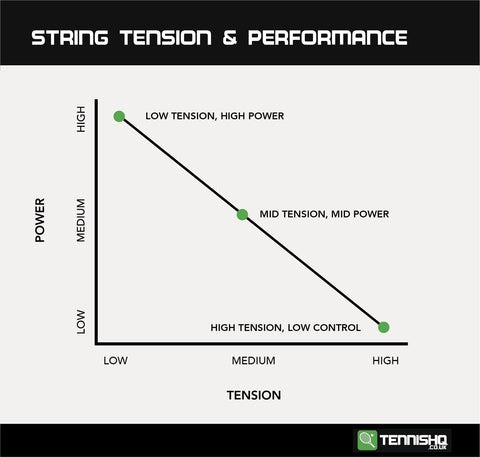
Start with the tension range specified for your exact racket model, then account for the string you're installing. A number that feels excellent in one frame can play differently in another, even for the same player.
The range may appear on the racket itself or in the manufacturer's model documentation. Identify the model and version precisely before you use it. If the specification is missing or unclear, a stringer can resolve it, including any restrictions from the string manufacturer.
Once you have the range, use its midpoint as your starting reference. Tennis Warehouse recommends this for synthetic gut, natural gut and multifilament strings, and suggests starting about 2 lb below the midpoint for polyester or Kevlar.
Wilson also publishes starting bands by material:
| String configuration | Wilson's starting band |
|---|---|
| Nylon or natural gut | 50 to 60 lb |
| Polyester | 44 to 54 lb |
| Hybrid | 46 to 56 lb |
The values come from Wilson's string-tension guide.
For a hypothetical frame labeled 48 to 58 lb, the midpoint is 53 lb. Your string choice decides whether another setting inside that range suits you better.
One r/10s player, already on poly, considered 48 lb after hearing that poly belongs in the 40s:
I've been playing with poly strings on my Pure Strike 18x20. I've recently seen some advice on YT (Intuitive tennis) and other forums saying the optimal string tension for poly strings is in the 40s. I'm thinking of adopting this and stringing my racket with Volkl Cyclone at 48lbs to start. How low have y'all gone and is it accurate to say that poly should be strung in the 40s? I've never played with anything other than poly strings because i like the spin from the polys and i've heard that mulitfilament strings etc. won't give as much topspin as the polys because of the texture (of course I'm aware most of the topspin generated is from your technique, but the poly strings do help out a bit).
The poster names a Pure Strike 18x20, Volkl Cyclone and a proposed 48 lb. Even an experienced polyester player needs the exact frame instructions and the chosen string before getting a useful answer. If your current setup already works, give your stringer the string and tension it uses.
Lower vs. higher string tension: power, control, spin and feel
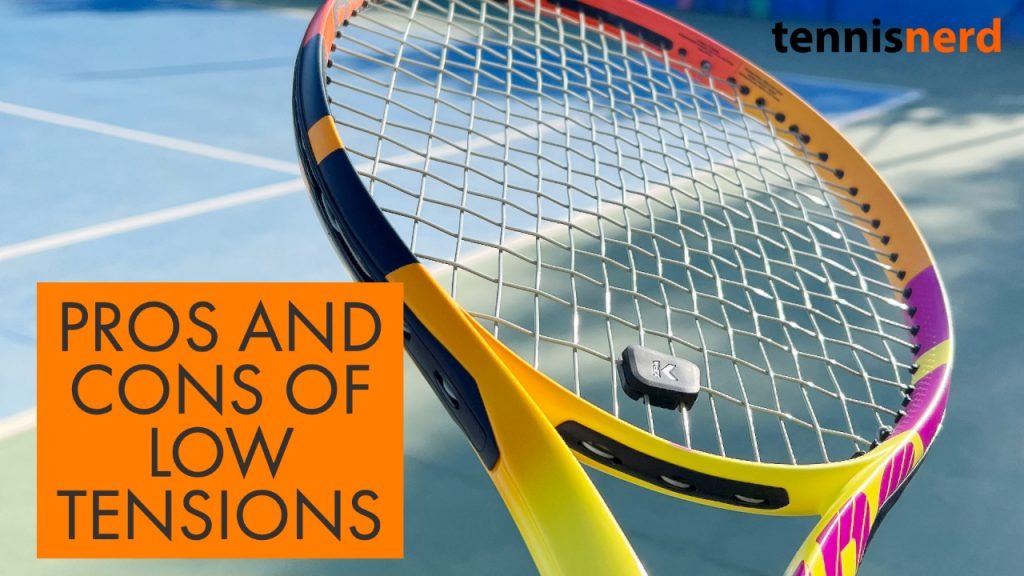
Higher tension makes the stringbed firmer. Lower tension makes it softer. What that does to your shots depends on your swing.
Players lump several effects under the word power. A deeper ball, a higher launch trajectory and a faster measured ball speed are three separate outcomes.
Control varies by task. You might want a predictable launch angle. Someone else might mean the confidence to accelerate through the ball. A tighter response changes the feel and trajectory, but it won't fix inconsistent contact or poor shot choice.
Spin comes from string movement, friction, snapback and racket-head speed working together. Tennis Warehouse's technical comparisons examine string-to-string friction and related properties. The spin you get depends on your stringbed and your stroke.
When someone says a setup gives them “more control,” ask what they actually see: shorter misses, tighter directional grouping, more predictable depth or better confidence. Each needs a different comparison.
If clean balls keep landing long on a fresh, consistent setup, try a modestly higher tension within the permitted range. If comparable shots keep falling short, try a lower one. Both are tests, because technique, shot selection or old strings can also explain the miss.
Pick one problem first: landing depth, directional dispersion, trajectory or the feel of contact. That gives the trial a target.
Why the same pounds can feel different with polyester, multifilament or hybrids
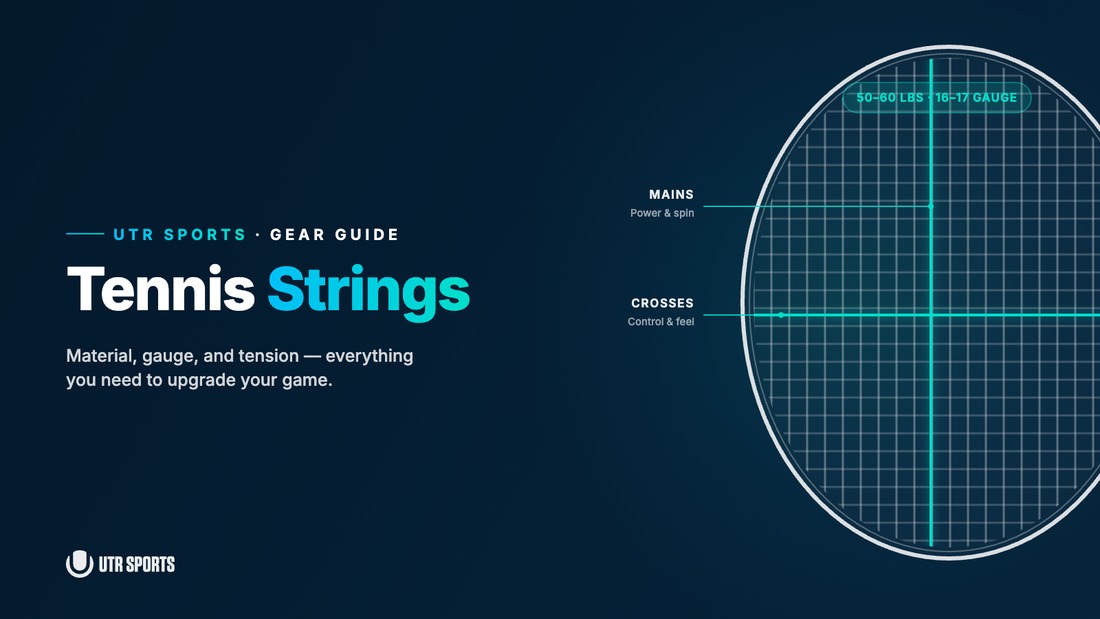
Tension is the stringer's machine setting. The string's construction shapes how the installed stringbed responds.
Two rackets strung at 52 lb can feel different when one uses polyester and the other multifilament. Products within one material category also vary in stiffness and tension loss. Tennis Warehouse University compares these properties, along with friction and energy return.
| String setup | Characteristic | What it means for tension |
|---|---|---|
| Synthetic gut or nylon | Construction and elasticity differ by product | Use the exact string instructions and frame range |
| Multifilament | Often designed to feel more compliant than conventional stiff polyester | A familiar polyester tension can feel different here |
| Natural gut | A distinct elastic material with its own response | Don't assume it behaves like nylon |
| Polyester or co-polyester | Often comparatively stiff at the same tension | Consider the specific formulation and compatible starting guidance |
| Hybrid | Mains and crosses can use different materials | Each direction may need its own tension |
Racket geometry matters too. The ITF explains that longer string spans in larger racket heads can deflect more under a comparable load, which changes the response even at the same nominal tension.
Mains run lengthwise through the racket head. Crosses run across them. A hybrid uses different strings in each direction.
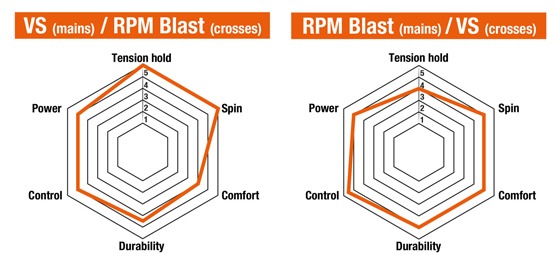
Wilson's worked hybrid example uses polyester at 51 lb and nylon at 53 lb. Tennis Warehouse separately describes a heuristic of roughly 5% lower tension for the polyester component of certain hybrid arrangements.
Gauge also changes the response, separately from tension.
Our guide to tennis string types compares constructions and their playing characteristics.
The tension you request is not the tension your racket keeps
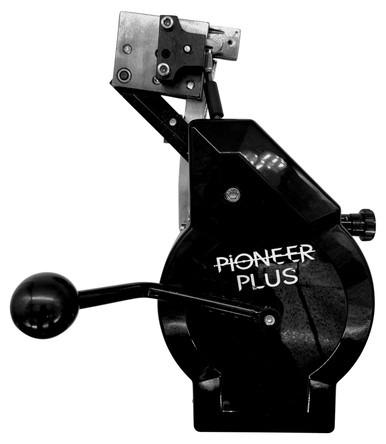
When you ask for 50 lb, you tell the stringer what pull to use on the machine. The forces in the installed strings then change during stringing and afterward.
Stringing changes several things. Strings stretch and relax. Friction acts where strings cross or touch the frame. The frame deforms under load. After the racket leaves the machine, the stringbed keeps changing with time and use.
Four different measurements are in play:
- Requested tension: The pull set during string installation.
- Individual string force: The force in one installed string at a given time.
- Stringbed stiffness: The response of the assembled string network.
- Dynamic string stiffness: A material response measured under specified test conditions.
The requested tension is the one number a shop can reproduce.
Cross and Bower's 2001 study, Measurements of String Tension in a Tennis Racket, found that installed tensions immediately after stringing were typically around 30% below the machine pull in their experimental conditions.
Don't add 30% to your request to compensate. You would get a different stringbed and could exceed the frame or string instructions.
A machine may display pounds-force or kilogram-force. For reference, 50 lb-force is approximately 22.7 kgf.
On a hybrid order, mains and crosses can have separate tensions, so list the units and values for each.
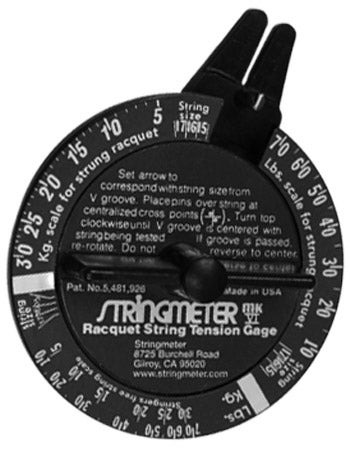
A Stringmeter or an acoustic phone app can measure a strung racket. Neither reliably tells you the original machine setting.
Why a freshly strung racket may feel different after a few sessions

A racket that felt excellent right after restringing can feel different several sessions later. The stringbed has changed.
Strings relax and lose tension, and their response shifts with use. You notice it as a different launch, sound, firmness or feel at impact.
Players describe it as springy, dead, launchy or boardy. Those words describe feel, not a particular remaining string force.
| Observation | Possible cause | How to read it |
|---|---|---|
| Shots begin launching differently after use | Changes in stringbed response | Compare with how the same string job played earlier |
| Strings feel unusually soft or springy | Material relaxation or other setup changes | Separate the feeling from a measured value |
| The result changes after switching strings | Different construction or gauge | Treat the new string job as a different setup |
| A later measurement reads lower | Tension loss or a different measurement method | Find out what the instrument measures |
One player described how quickly a good impression can change:
I play twice a week, usually 2 hours a session give or take 30 in either direction. I’m 40 years old and play with the new Mach-10 string. I love it, it’s soft, and when it’s strung at 50-49lbs, it plays amazing. After just two hitting seasons with friends - roughly 3/4 hours of tennis. The tension has dropped to 46, and it’s starting to feel springy, and I can’t swing my normal swing. Is there a fix for this? Should I string higher than the recommended 50? I love the softness of the string, but hate that I can’t rip a forehand a few hours in without diminishing results. Any suggestions would be helpful. Thank you.
The opening post reports a 50/49 lb installation and a later reading near 46 after roughly three to four hours. In follow-up replies, the player names RacquetTune as the measurement method. Both readings are self-reported, with no independently calibrated comparison to the original machine pull.
A setup that feels great at first can feel unfamiliar as it ages. Asking for a much higher starting tension changes the fresh string job, and the original feel still won't return later.
Track the installation date, how much you've played and any change in string, frame or measurement method. If the strings have worn in, read when to restring a tennis racket next.
How to test a different tension without confusing the result
A good tension test starts with a setup you can describe exactly. Change one thing and measure one playing result.
A string job costs money, and changing several things at once makes the result impossible to read.
One r/10s player described a big improvement with Hyper G at 52 lb, followed by more experiments with hybrid strings and another racket:
Im a good intermediate and play with Head Speed MP (2025) . Having always been naive to strings, I recently tried Hyper G at 52lbs and it was revelatory to my game. I felt like twice the player for the 10 hours it lasted . Better spin, control, rarely hit long , reliable kick serve and had so much confidence and trust in my ability. I've been trying to hone in and perfect this feeling and so I've been testing some hybrid HyperG/Confidential and Hyper G/Multi set ups and tried Tourbite in my pure drive but it's not even close to the sensation of those sessions I had with Hyper G so I'm waiting for the stringer to get Hyper G back in my Speed MP (slightly nervous that feeling won't come back) My question is whether I'm overcomplicating this and obsessing unnecessarily. Strings don't fix your ability and technique I know that but it genuinely did feel so transformative to my game and like I was in harmony with my set up rather than fighting against it.
The later experiments changed both strings and racket models, so tension's individual contribution stays unclear.
- Define the baseline. Note the racket, full string setup, tension and how it plays now.
- Set a measurable target. For the depth result you chose earlier, define a landing zone and score both setups against it.
- Change one setting. Keep the frame, string product, gauge and main/cross arrangement the same. Use the same stringer, machine and procedure where possible. Stay within the documented limits.
- Compare similar hitting. Use comparable balls, courts and rallies. Compare string jobs at a similar point after stringing, since tension loss tends to be fastest early on. Record results separately from feel.
- Repeat before judging. Give the new setup more than one comparable session when you can.
- Keep or change. A small, repeatable benefit is worth keeping. If the difference is unclear, your previous setting is a fine choice.

For a simple personal test, hit 20 comparable rally balls toward a defined depth zone and count how many land there. Repeat with the new setup under similar conditions.
Log directional misses, perceived launch, comfort and confidence separately. One overall impression of “better” hides which property changed.
If your current setup plays well, wait for your next normal string job instead of paying for an experiment you don't need.
When strings are not the problem
If you keep missing because of inconsistent contact or shot selection, get coaching on the stroke before adjusting your strings again. For persistent arm pain, numbness or similar symptoms, see a qualified clinician. No tension here is established as a treatment or preventive measure.
Why research does not give everyone the same ideal tension

Controlled experiments show how tension affects performance under defined conditions. Their findings depend on the players, equipment, shots and outcomes tested.
| Study | Participants and tested conditions | Main relevant finding |
|---|---|---|
| Zhao, Li and Liu (2025) | 15 male university tennis athletes; 48, 54 and 60 lb; forehands | The middle setting, 54 lb, produced stronger measured outcomes than 60 lb in the tested task |
| Yang, Sun and Ren (2026) | 27 trained players; 40, 45, 50, 55 and 60 lb; forehands and backhands | Accuracy differed significantly across tension conditions; overall ball speed did not differ significantly in the reported protocol |
| Bower and Cross (2003) | 41 advanced recreational players; tension-discrimination testing | Many players had difficulty correctly identifying tension differences by feel |
The 2025 PLOS ONE experiment measured mean ball speeds of 108.87, 111.83 and 107.76 km/h at 48, 54 and 60 lb, respectively.
Its control scores were 4.90, 5.46 and 4.64. The 54 lb condition had the highest mean on both measures in this group of 15 male university athletes.
The 2026 Frontiers in Psychology experiment used five identical rackets and a randomized testing order. Among 27 trained players, it reported a significant tension effect on accuracy, F(4,100) = 40.37, p < 0.001, but no statistically significant overall ball-speed effect.
Feel is a separate problem. In Bower and Cross's 2003 experiment, 11 of 41 players correctly identified a tension difference of 5 kg, approximately 11 lb, or less. Fifteen of the 41 could not distinguish even a 10 kg difference, approximately 22 lb, under the experimental conditions.
Copy this tennis stringing order and testing checklist
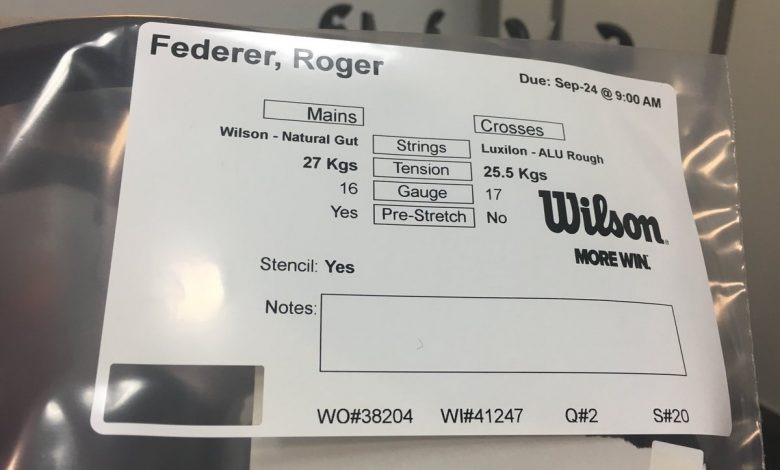
A good stringing request describes the whole setup. The stringer can reproduce the job, and you get a reference for later comparisons.
Stringer Setup Card
- Racket: Brand, exact model and version:
__________ - Permitted range: Documented frame range:
__________ lb / kgf; source of specification:__________ - String instructions: Product-specific constraints or relevant instructions:
__________ - Configuration: Full bed / hybrid:
__________ - Main strings: Brand, model, material and gauge:
__________ - Cross strings: Brand, model, material and gauge:
__________ - Requested tension: Mains:
__________ lb / kgf; crosses:__________ lb / kgf - Previous setup: Racket/string/tension details, if known:
__________ - Job details: Date:
__________; stringer or machine information, if available:__________
If the permitted range is unresolved, leave the tension fields blank and mark them CHECK BEFORE STRINGING.
Two-session tension comparison log
- Baseline setup: Frame, string product, gauge, mains/crosses arrangement and tension:
__________ - Single changed field:
__________ - Target result: Depth / directional accuracy / trajectory / feel:
__________ - Session 1: Setup tested (baseline / changed):
__________; time or play since stringing:__________; court and ball conditions:__________; result:__________; feel:__________ - Session 2: Setup tested (baseline / changed):
__________; time or play since stringing:__________; comparable conditions:__________; result:__________; feel:__________ - Decision: Keep the new setup / retain the previous setup / discuss another adjustment:
__________
For example, you might keep your racket and full-bed synthetic gut and change only the requested tension at your next string job, with directional placement as the target. The log records the rest of the conditions.